
Art Classes, Workshops and Events in Carrollton, TX
Carrollton students have one of the shorter drives on this page list: about twenty minutes east on the George Bush Turnpike to the Art Be You studio in Richardson. What they get for the drive is a working painter’s studio class. Four to six students, three hours, all materials included, and teaching that follows your painting rather than a calendar. Carrollton has community programs and paint and sip nights. It does not have this. If you are searching for art classes in Carrollton, TX because you want to actually learn to paint, you are in the right place.
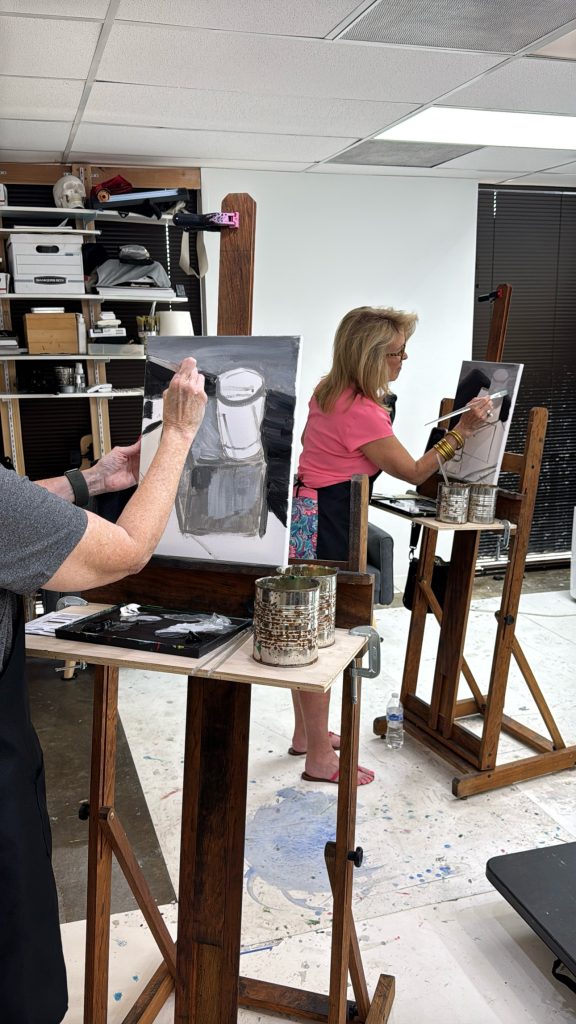
Art Be You is led by Bartosz Beda, a professional painter with an international exhibition record and years of experience teaching adults, children, and seniors. His studio classes are kept deliberately small, so that every student is corrected individually, every evening, on their own canvas. People underestimate how much that matters until they have had it.
Painting Classes for Carrollton Adults
The studio runs two courses each week, on Tuesday and Thursday evenings from 6 to 9 PM, timed for people who work days. Carrollton drivers come east on TX 190 or up through Addison and along Belt Line, and arrive before the lot fills.
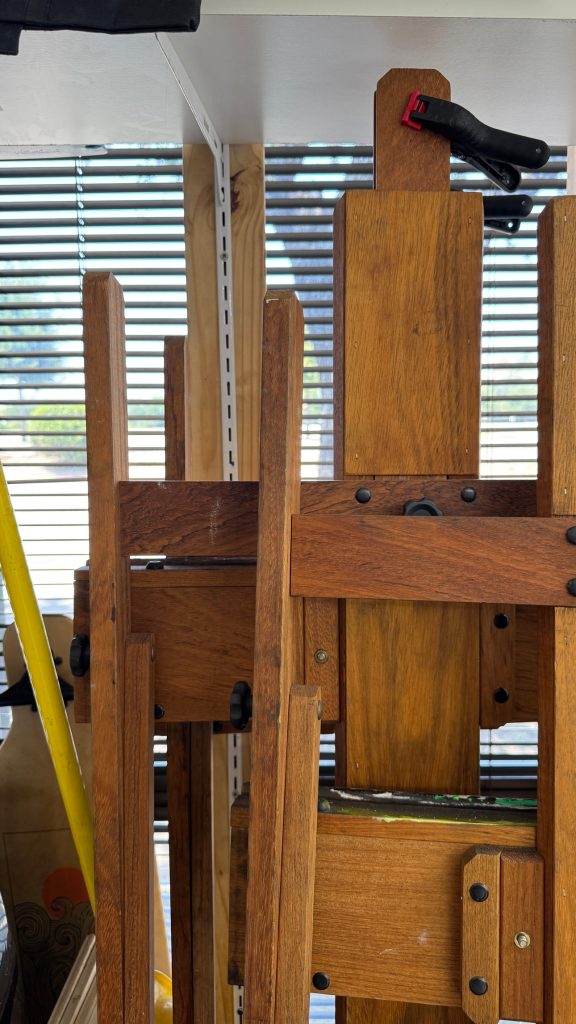
The acrylic painting course meets on Tuesdays. Each painting moves through the same professional sequence: composition and drawing, a tonal underpainting, color laid in stages, and finishing passes. The teacher paints his own demonstration canvas in front of the class, then works the room, easel by easel. Acrylic is the forgiving medium for a weekly class. Mistakes paint over, layers dry by the following week, and the car ride home is never a problem.
The watercolor painting course meets on Thursdays. Here the teaching is timing: the water in the brush, the dampness of the sheet, the order in which washes meet. Students start with exercises in control and graduate to full paintings within the session, with the teacher adjusting each student’s plan before the first wash goes down.
There is no fixed curriculum imposed on every room. The work follows the students in it. A first time painter from north Carrollton and a returning student from the historic district get different assignments in the same evening, because they need different things. Sessions run in short blocks through the year. For current dates and open seats, see the class pages, and compare both courses on the art classes overview.
Workshops That Come to You in Carrollton
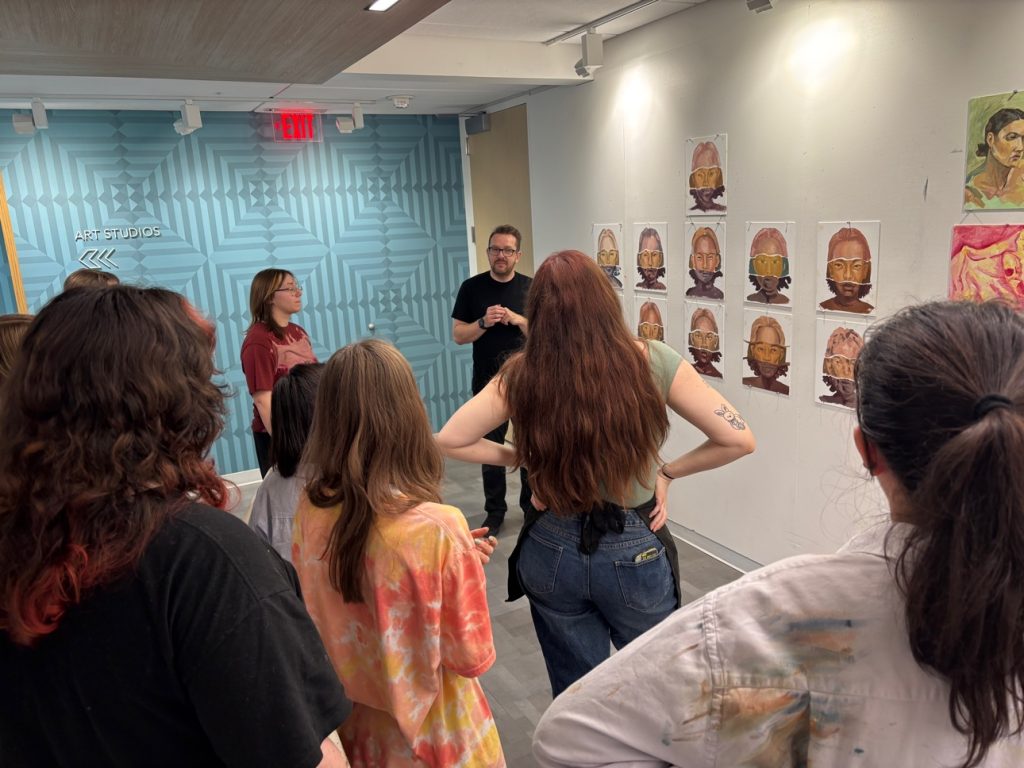
Groups in Carrollton do not need to travel at all. A workshop is a complete painting session of about ninety minutes, held in your room. The teacher brings everything: paints, brushes, canvases, table covers, and printed instructions. He sets up, teaches, and cleans up afterward. Everyone leaves with a finished painting.
Senior communities in Carrollton and along the Metrocrest corridor book painting workshops as regular programming. Residents paint from canvases that arrive with the drawing already sketched, so the ninety minutes is painting, conversation, and the satisfaction of finishing, with no drawing test at the door. Sessions pace to the room, and memory care groups are welcome.
Corporate teams along the I-35E and Tollway corridors book workshops for holiday events, team days, and client evenings. Up to thirty people paint together for about ninety minutes, and the only thing the host provides is the room and the people. The full offer is on the art workshops page.
Private groups book birthday sessions, neighborhood groups, and friends who would rather paint together at the studio than meet in a restaurant for the tenth time.
Carrollton and the Arts
Carrollton’s art life is modest and real, anchored by a genuine historic downtown that most suburbs lost long ago.
Historic Downtown Carrollton Square. The old town square, at Broadway and Main near Belt Line Road, is the city’s center and its best painting walk. The square took shape before 1900 around a spring that flowed where the gazebo now stands, and its brick storefronts, early buildings, and the tall grain silos beside the railroad tracks give Carrollton a silhouette no planned suburb can fake. The 1921 gazebo still hosts gatherings. A student can walk the whole square in twenty minutes and come home with a dozen compositions.
Plaza Arts Center. The city’s arts venue on Fourth Avenue near the square, the Plaza Arts Center hosts concerts, community theatre, film, and local exhibitions in a renovated historic building. It is where Carrollton performs for itself. Students attend to see neighbors on stage and local work on walls, and several have shown work in its community exhibitions.
A.W. Perry Homestead Museum. At 1509 North Perry Road, the city maintains the 1909 homestead built by DeWitt C. Perry from materials salvaged from his family’s 1857 home, on land the Perrys claimed in the 1840s. The rooms are furnished in period style, and group tours are free. It is the finest surviving picture of how this land looked when it was farms, and the house, porch, and trees make a clean architectural subject for a Saturday sketch.
Josey Ranch Lake. In north Carrollton, the lake and its trail loop are a known birding spot, with herons, egrets, and winter waterfowl on a suburban lake. Nature photographers work its edges at dawn, and our landscape students do the same with sketchbooks. It is the easiest wild subject in the city.
Carrollton’s Korean community. Carrollton is home to one of the largest Korean American communities in Texas, centered on the shopping and dining districts along Old Denton Road and Belt Line. Its markets, festivals, and sister city ties give the city a second cultural calendar, and our Carrollton classes are richer for the students it brings. A still life from a Korean market, radishes, melons, dried peppers, is a painting lesson in itself.
What Carrollton Students Paint
Carrollton’s material divides neatly in two: the railroad town that survives downtown, and the greenbelt that runs through everything else.
The grain silos. The tall concrete silos by the tracks east of the square are Carrollton’s landmark, visible from half the city. Students paint them as what they are: prairie skyscrapers, plain concrete taking on the full drama of a Texas sky. It is the best local exercise in making an unbeautiful thing hold a picture.
The square at festival time. The city’s fall festival fills the historic square with stages, booths, and crowds, and the rest of the year the same streets are quiet enough to draw undisturbed. Students use both versions: the empty square for architecture, the festival for figures and movement.
The Elm Fork greenbelt. The Trinity River’s Elm Fork runs along Carrollton’s western edge, with trails, bottomland woods, and floodplain lakes. It gives the city a real landscape school within its borders, green in spring, gold in November, minutes from any Carrollton driveway.
Josey Ranch Lake at dawn. Still water, mist, and white egrets against dark trees. Watercolor students are sent there first, because the whole scene is three values and patience.
Carrollton students often arrive saying their city has no subjects, and leave their first session with a list of twenty. The subjects were always there. Painting is mostly learning to notice what a place actually looks like.
A Short History of Carrollton
The first settlers arrived in the early 1840s under the Peters Colony land grant. William and Mary Larner came in 1842, and the A. W. Perry family followed in 1844, claiming land around Trinity Mills, where Perry and his partners ran a gristmill on the Elm Fork. The settlers farmed the blackland prairie and built churches and schools; the first Baptist church in Dallas County was established near here in 1846.
The town most likely took its name from Carrollton, Illinois, the hometown of many of its settlers, a name that traces further back to Charles Carroll of Carrollton, the Maryland signer of the Declaration of Independence. The name became official on May 16, 1878, when the first post office opened. Railroads followed, and by the late 1880s two lines crossed at Carrollton, making it a shipping point for cotton, grain, and gravel. The town square formed around 1900, the first city hall rose in 1923, and the Plaza Theater opened on the square in December 1949, showing films until 1994.
Carrollton incorporated on June 14, 1913, by a vote of 52 to 23, with W. F. Vinson as its first mayor. It remained a small farming and rail town well into the modern era; a working cattle ranch survived inside the city limits into the 1980s. Then the metroplex arrived. The George Bush Turnpike, I-35E, and the Tollway put Carrollton inside the suburban ring, and the population passed 133,000 by 2020. Korean and other Asian communities grew along its western corridors into one of the metroplex’s defining cultural districts.
Our Carrollton students carry that layered history into the class without thinking about it: farm families of five generations beside families who arrived from Seoul five years ago, all learning the same craft at the same table. The class works because painting levels everyone to the same honest problem, the blank canvas, and Carrollton people seem to like that about it.
Getting to the Studio from Carrollton
The studio is in Richardson, about twenty minutes east. The fast route is the President George Bush Turnpike (TX 190) from I-35E or the Tollway straight across to the Richardson exits. Belt Line Road and Arapaho Road also run east into Richardson for students who avoid tolls. Classes begin at 6 PM, and most Carrollton students are parked by 5:50.
DART’s Green Line serves downtown Carrollton station and connects through downtown Dallas to the Red Line for Richardson, and the Silver Line, now opening through the city, adds an east-west option with a Richardson station of its own. Driving remains the simpler trip for an evening class. Parking at the studio is free, in the lot by the door.
Questions Carrollton Students Ask
Is twenty minutes each way too far for a weekly class?
Our Carrollton students are among the most consistent attenders we have. Three hours of class against forty minutes of driving is a ratio people accept once the first painting comes home.
Can my teenager take the adult class?
The evening courses are adult classes, and older teenagers who can work independently for three hours are welcome to ask about a seat. Children’s teaching is arranged separately, so contact us with the student’s age.
Do you teach in Korean or other languages?
The class is taught in English. In practice, painting demonstration is a visual language, and students with limited English follow it well, with classmates often helping. Everyone is welcome at the table.
Can our Carrollton office or senior community book a single workshop?
Yes, single sessions are the standard booking. See the art workshops page and send your date and group size.
Is there a gift option that works for any schedule?
Yes. A gift art class covers a full session, and the person receiving it picks the course and the session dates.
Start Painting, Carrollton
Your city kept its square, its silos, and its homestead while everything around it changed. The same eye that notices that can learn to paint it. Choose the acrylic painting course on Tuesdays or the watercolor painting course on Thursdays, and check the current session on the class page.
All the cities we serve are collected on the Where We Teach page, and the studio posts student work on Instagram and Facebook each week.