For most of my career, I operated under a very specific, traditional definition of success.
The script was simple, or so I was told in art school: You go to a prestigious university (Manchester School of Art). You get the Master’s degree (visit my website here: Bartosz Beda). You win the awards (The Torwy, The Catlin Guide). You get the residencies and fellowships (Rome, Dresden, San Angelo). And then, you lock yourself in a room, paint masterworks, and wait for the galleries to sell them. In this old model, the artist is a hermit, and the income is a result of the object.
But 2025 was the year the script finally burned up.
It wasn’t just me; it was the entire ecosystem. The art market, always fickle, became dangerously silent. The gallery model, which had served as the gatekeeper for a century, began to buckle under the weight of a changing economy and a digital landscape that fragmented attention spans. I found myself in a position that many mid-career artists fear but rarely discuss publicly: I was doing everything “right,” yet the financial stability I was promised felt like a mirage.
I realized I had two choices. I could continue to sit in my studio, paralyzed by the anxiety of the next sale, waiting for permission to be successful. Or, I could open the doors.
I chose to open the doors.
This year, 2025, has been the most transformative year of my professional life, not because of a museum show or a record-breaking auction result, but because I made the conscious decision to pivot from being purely a maker of art to being a facilitator of art. I founded Art Be You not just as a business, but as a survival mechanism for my own creativity, and in doing so, I discovered a profound truth: Teaching didn’t take away from my practice. It saved it.
Breaking the Silence (February 2025)
The shift began in February. The winter months are notoriously slow for art sales, and the silence in the studio was becoming deafening. The isolation of the painter was starting to feel like a cage.
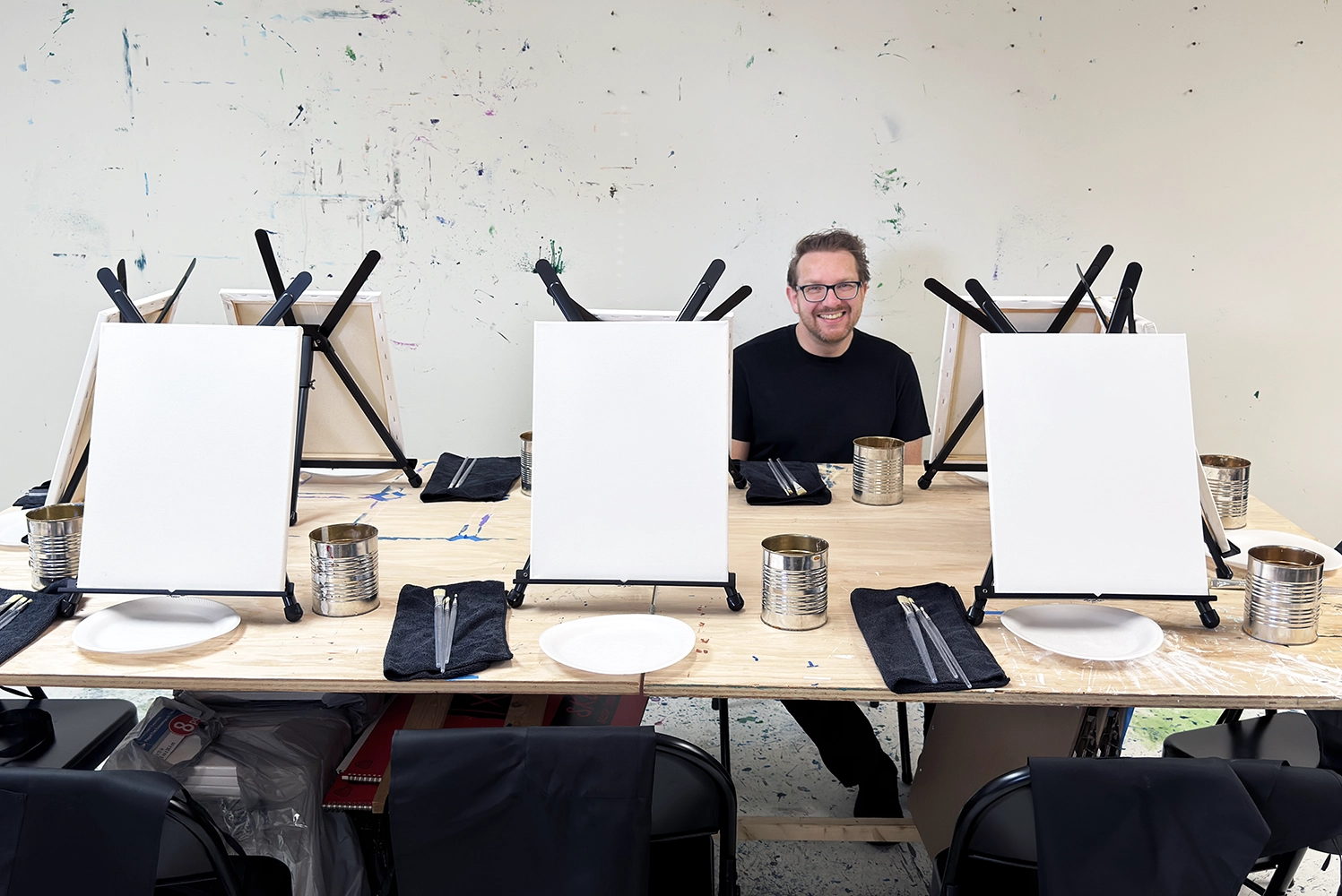
I decided to run a pilot program: small, intimate group classes right here in the studio.
I was nervous. There is a stigma in the high-art world, a whispered prejudice that says, “Those who can’t do, teach.” I worried that by offering classes to beginners, I was somehow diluting my brand as a serious contemporary painter. I worried that my collectors would see it as a sign of weakness.
I was wrong.
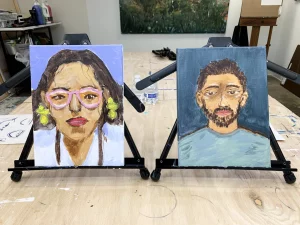
The first group that walked through my doors didn’t care about my CV. They didn’t care about the Catlin Guide or my exhibition history in the UK. They were people like accountants, nurses, retirees, who were starving for a tactile experience. They lived in a world of screens and spreadsheets, and they just wanted to know what it felt like to push heavy-body acrylic paint across a canvas.
When I started teaching them, something shifted in me. I found myself explaining concepts of composition, color theory, and abstraction that had become instinctual to me over the last 15 years. By verbalizing them, I was re-learning them.
I watched a student, a woman in her 40s who claimed she “couldn’t draw a stick figure,” make a mark that was confident and bold. I saw the physical release of tension in her shoulders. And for the first time in months, I didn’t feel the crushing weight of the art market. I just felt the joy of the material.
That February pilot was the spark. It proved that there was a hunger for high-level art education that wasn’t stuffy or academic, but accessible and human.
The Italian Connection
In the spring, I traveled to Italy. Europe always has a way of resetting my perspective, but this trip was different. In Italy, art is not a luxury product reserved for the wealthy elite; it is woven into the fabric of daily life. You see it in the architecture, the food, the way people dress, and the way they gather.
I observed how older generations in Italy remained integrated into the community. They weren’t hidden away; they were in the piazza, engaging, arguing, living.
It made me think about the senior communities back in Dallas. In the US, we often silo our seniors. We put them in beautiful facilities, but we sometimes starve them of genuine, challenging engagement. We give them bingo and puzzles, but we rarely challenge them to create.
I realized there was a massive gap in the market. Senior living facilities didn’t need “activities” to pass the time; they needed programming to engage the mind. They didn’t need a babysitter with a box of crayons; they needed a Master of Arts who treated them like intellectual adults.
I came back from Italy with a new mission for Art Be You: To bring university-level art instruction to the retirement community.
San Angelo and the Senior Pivot
The proof of concept happened during my residency in San Angelo later that year.
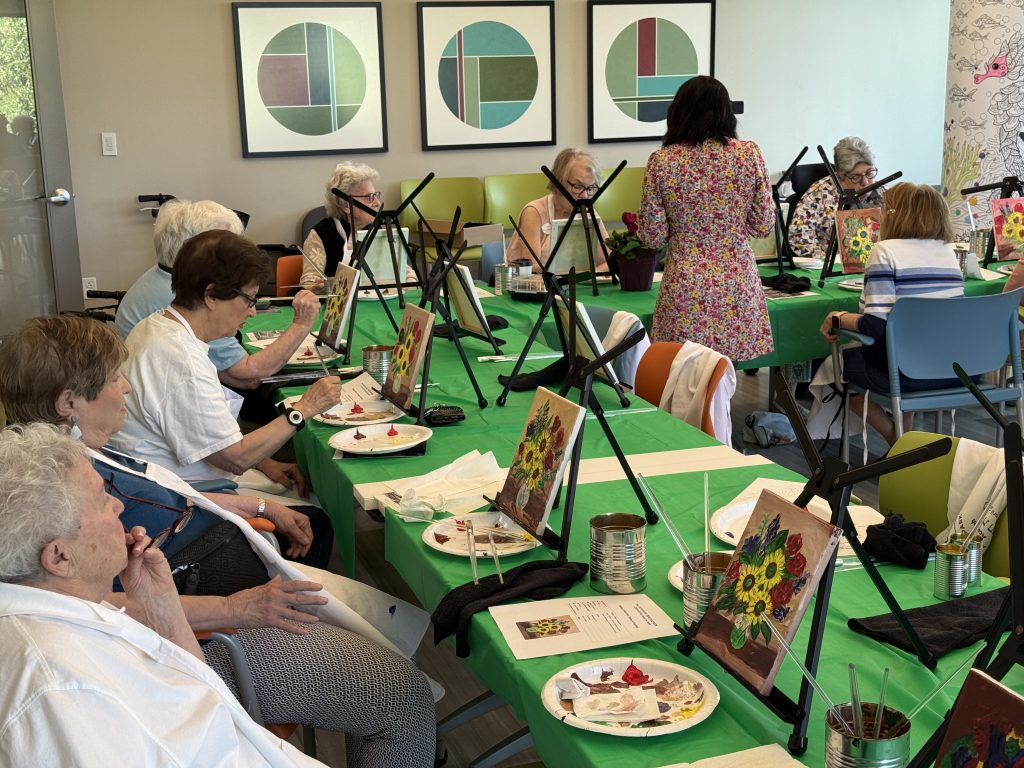
While I was there to focus on my own painting, I began reaching out to local retirement houses. I pitched them a simple idea: Let me teach your residents how to paint. Not a craft project. Real painting.
The response was overwhelming.
This is the power of art that the commercial gallery world ignores. The gallery world cares about provenance and investment value. But in that room in San Angelo, the value of the art was medicinal. It was neuroplasticity in action.
I realized that my skills as a painter and my ability to see color, to understand form, to navigate the unknown on a canvas were transferable assets. I wasn’t just making objects for rich people’s walls anymore; I was giving people a language to express things they had forgotten how to say.
When I returned to Dallas, I aggressively expanded this program. I started contacting Activity Directors at places and other premier communities. I told them: “I provide everything. The easels, the paints, the instruction. You just provide the room.”
It worked. The business began to grow.
The Economics of Sanity
Let’s talk about the money. Artists are trained never to talk about money, which is why so many of us are broke.
For years, my financial and emotional well-being was 100% correlated to whether a gallery director liked my new series. If I sold a painting, I was a genius. If I didn’t sell for three months, I was a failure. That rollercoaster is unsustainable. It destroys your mental health, and eventually, it destroys the art itself because you start painting out of fear.
In 2025, I decided to get off the rollercoaster.
By building Art Be You, I created an income stream that I control.
- I don’t have to wait for a collector to “discover” me.
- I can go out and find a corporate client who needs a team-building workshop.
- I can book a month of senior classes and know exactly how much money is coming in.
This shift did something incredible for my studio practice: It gave me my freedom back.
Because the classes now cover a portion of the bills, I don’t walk into my studio with the smell of desperation. When I paint now, I paint what I want. I am not thinking, “Will this match a beige sofa?” I am thinking about the work.
Diversifying my income didn’t make me less of an artist. It made me a better artist because it removed the gun from my head.
The “Art Be You” Philosophy
As we close out 2025, Art Be You has evolved into something bigger than just me giving lessons. It has become a platform for a specific philosophy of creativity.
We live in an era of AI and automation. In 2026, computers will be able to write better emails, generate faster code, and even create hyper-realistic images. But there is one thing AI cannot do: It cannot feel the resistance of the brush.
My classes, whether for a burnt-out corporate executive or a 90-year-old in memory care, are about reclaiming that humanity.
For the Corporate Team:
I teach them that “failure” on the canvas is just data. When you make a “mistake” in an abstract painting, you don’t delete it. You work with it. You layer over it. This concept of “Creative Resilience” is exactly what modern businesses are desperate for. They hire me not because they want to be painters, but because they want to learn how to think laterally.
For the Senior Community:
I teach them that they are still capable of growth. Society tells seniors they are finished learning. I tell them they are just starting. When a resident finishes a painting and sees it framed, their posture changes. They feel pride. That pride is the product I am selling.
For the Private Student:
I teach them to see. Drawing is not about hand-eye coordination; it is about learning to look at the world and see the truth of shapes and shadows, rather than the symbols our brain invents.
Conclusion: Looking to 2026
I am still a painter. My Chief Aim is still to build the Art Chapel and leave a legacy of work that defines my generation. That hasn’t changed.
But the method has changed. I am no longer a passive participant in my own career. I am an artist-entrepreneur.
If you are reading this, and you have been thinking about taking a class, or booking a workshop for your team, or bringing a program to your community, I invite you to reach out.
I am not a franchise. I am not a YouTube tutorial. I am a working artist who has walked through the fire of the creative process and wants to hand you a torch.
2025 was the year I stopped waiting.
2026 is the year we build.
Let’s paint.
Bartosz Beda is an award-winning artist and the founder of Art Be You and Execute Magazine. He holds an MA from Manchester School of Art. His work is exhibited internationally, and he lives and works in Dallas, TX.