
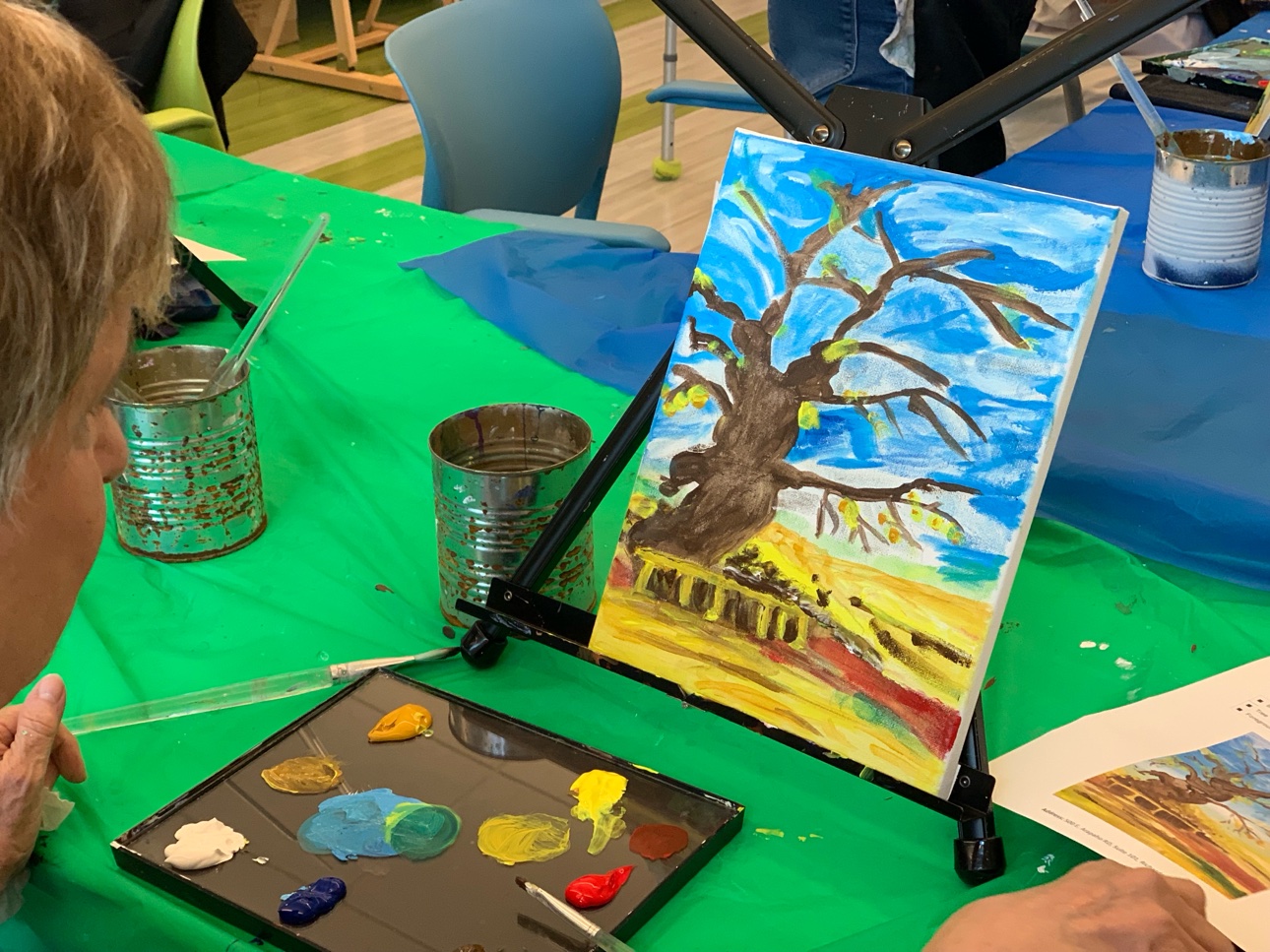
I bring painting workshops to senior living communities in the Dallas area. The workshop comes to your building. Your residents do not travel anywhere. I set up in your activity room, teach a full 90-minute painting session, and clean up when it is done.
Every participant finishes a complete painting in that one session. Not a half-finished project that needs another visit. A real painting, ready to hang on a wall or prop on a dresser the same day.
In October 2026 I taught one of these sessions at a senior community in Dallas, and the room worked exactly the way it should. Residents who had never held a brush sat next to residents who painted years ago. Everyone worked at their own pace. Everyone finished. The pattern is the same at every community I visit. Give people simple steps, a calm pace, and real materials, and they surprise themselves.
This page explains why painting works so well as a senior activity, what actually happens in a session, and what your community needs to provide. The short version is that your community needs to provide almost nothing.
Why Painting Works So Well for Seniors
Some activities ask a lot from the body. Painting asks very little, and it gives a lot back. A resident can sit comfortably for the whole session. There is no standing, no walking between stations, and no special clothing. The work happens at the table, at whatever speed the person in the chair chooses.
Painting also keeps the mind busy in a gentle way. Mixing a color, watching an edge, deciding where a tree should go. These are small decisions, and small decisions are good exercise for attention. They hold focus without pressure.
Here is what a painting session gives your residents:
- A fully seated activity that is gentle on joints, backs, and energy levels.
- Active hands and eyes, with real fine motor work that never feels like therapy.
- Natural conversation, because painting side by side makes talking easy.
- Memory prompts, since landscapes, houses, gardens, and skies remind people of places they have known.
- A finished object at the end, something made by their own hands.
- Something to show family on the next visit, and something to talk about during that visit.
That last point matters more than people expect. A finished painting gives a resident something new to say. Visits can fall into the same questions and the same answers. A painting on the wall changes the conversation. Family asks how it was made. The resident gets to tell the story.
Painting is also honest about ability. It does not punish a shaky hand. It does not require reading small print or hearing every word in a noisy room. A resident who misses a step can look at the demonstration painting, look at a neighbor’s work, and catch up quietly. Nobody falls behind in a way the whole room can see.
What Happens in a 90-Minute Session
The session lasts 90 minutes, start to finish. I arrive early, set up the room, teach the session, and handle cleanup afterward. Your staff does not run the activity. Your staff is welcome to watch, help a resident settle in, or simply enjoy a quieter hour.
Before We Start
I arrive about half an hour before the session and set up everything myself. I bring table easels, palettes, paints, brushes, aprons, and table covers. I lay out a place for each participant before anyone sits down, so the room looks ready and inviting when residents walk in.
Each seat gets the same setup, and every canvas already has the day’s image pre-sketched by me, so nobody has to struggle with drawing and everyone can start painting right away. Each participant also gets a printed instruction sheet with the image we are painting, the steps, and the brushes and colors to use. Nobody waits for supplies. Nobody shares a brush cup with three other people. When a resident sits down, everything they need is already in front of them.
Every workshop has a new theme and its own demonstration painting, which I paint earlier and bring with me. One session might be a landscape, another a still life, another a city scene, flowers, or animals. Returning residents never paint the same picture twice.
During the Session
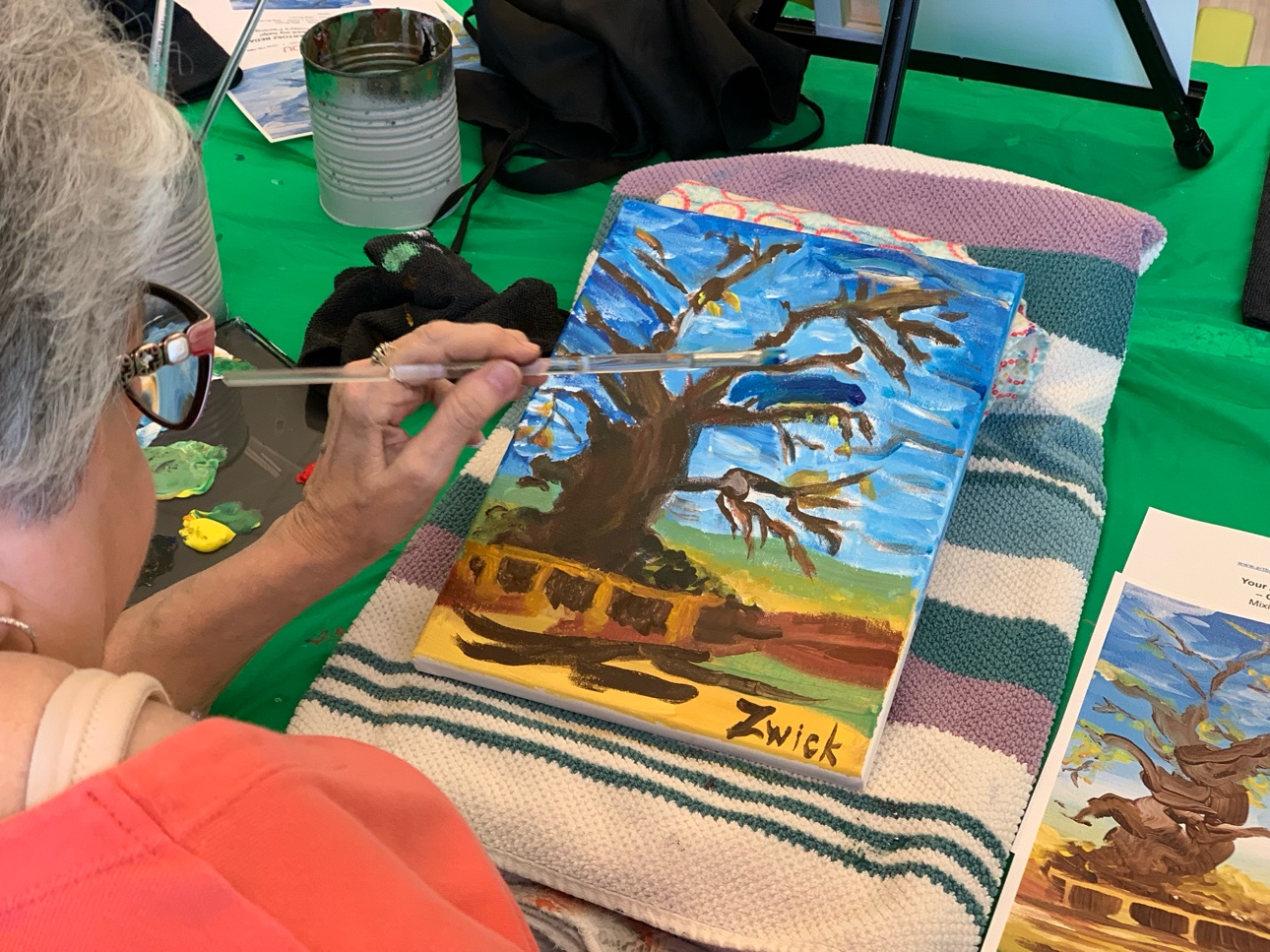
We paint one picture together, step by step. I paint the same picture at the front of the room, in large clear stages, and residents follow along on their own canvases. The steps are simple on purpose. A sky first. Then the big shapes. Then the details that make it feel finished.
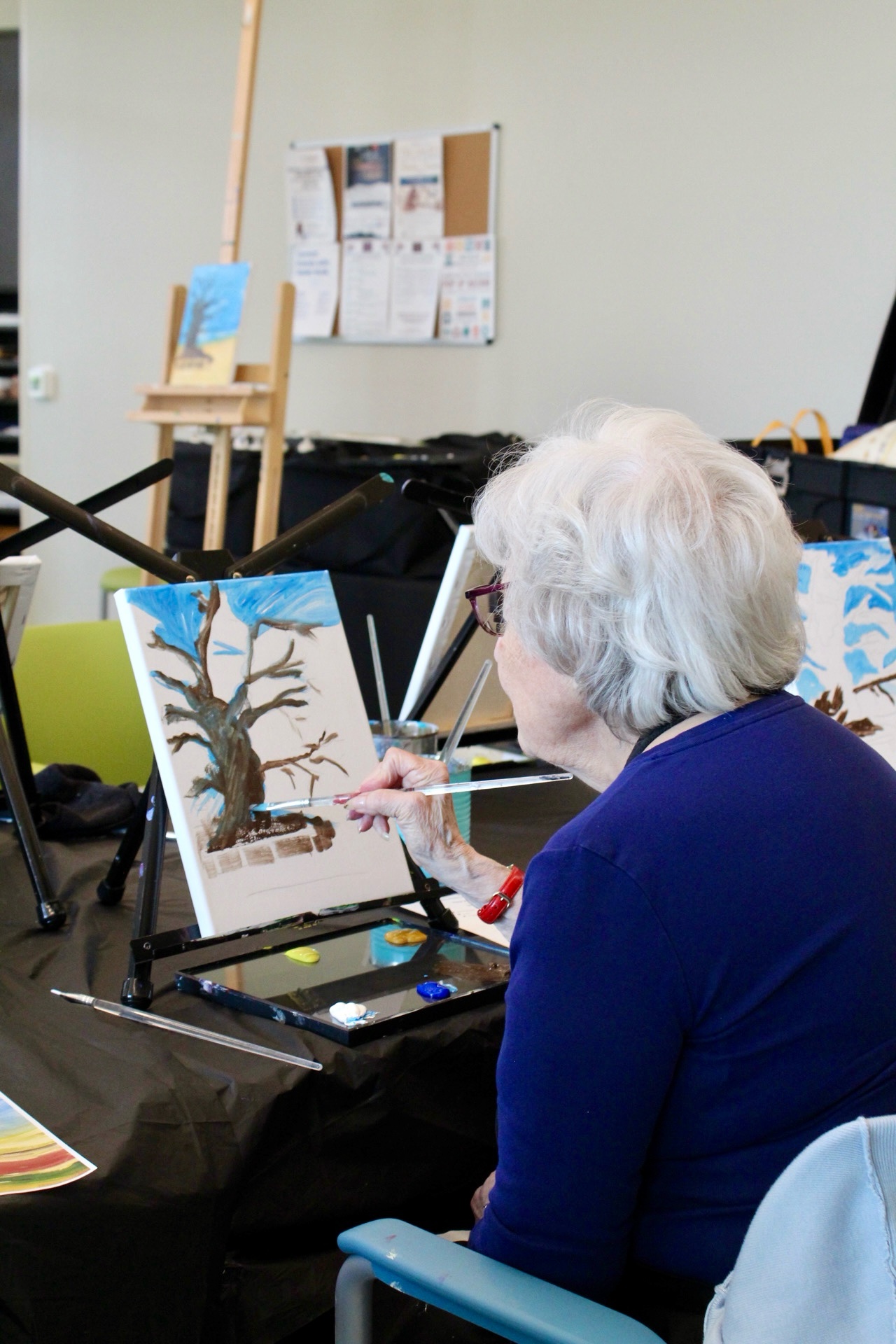
A few things guide how I teach:
- Every step is demonstrated big and slowly, so it can be followed from the back row.
- No step is rushed, and there is always time to finish before we move on.
- There are no wrong answers, because two paintings of the same scene should not look identical.
- Residents can follow the steps exactly or wander off in their own direction, and both are fine.
- I walk the room the whole session, giving more attention where it is needed and feedback where that is enough.
- If someone is stuck, I will pick up a brush and help them break that white canvas barrier so they can keep moving.
At the start I explain the paints briefly, including one practical warning. Acrylics are permanent once they dry, so anything that gets on clothes has to be washed out quickly or it stays. That is what the aprons are for.
Acrylic paint is the right medium for this. It dries fast, so a painting is safe to carry back to a room the same day. It is forgiving, because a mistake can be painted over once it dries. And it cleans up with water, which keeps the whole session simple for your building.
At the End
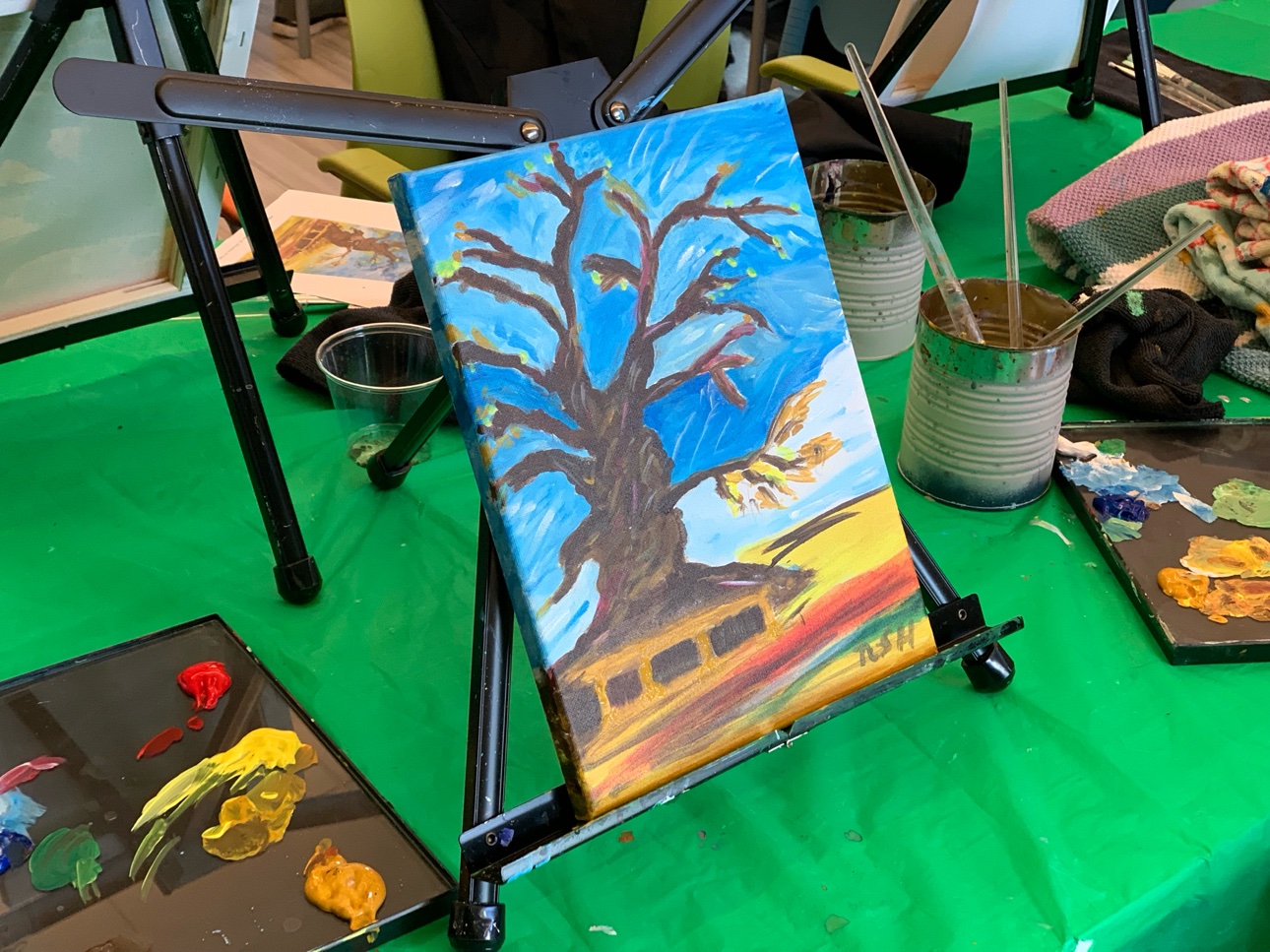
When the 90 minutes are up, every resident has a finished painting. We usually take a few minutes to look at each other’s work. That part is not a formality. People are genuinely pleased, and often a little surprised, at what the table produced. Then residents take their paintings with them, and I clean up myself: palettes, containers, and tables cleaned, everything packed and taken back to my studio. The room is left the way I found it.
What Your Community Needs to Provide
Almost nothing. This is the part activity directors usually ask about first, so here is the full list:
- A room where residents can sit together.
- Tables and chairs, the ones you already have.
- Residents who want to try.
That is all. I do not need a special art room. I do not need a sink in the room, storage space, or any supplies from your building. I bring the materials in, I set up, I teach, and I take everything away again at the end.
Scheduling is simple too. You pick a date that fits your calendar, and the session runs inside your normal activity programming. It works as a one-time event, a seasonal activity, or a regular visit. Families are often in the building for it, and family members who want to sit in and watch are welcome.
If you are comparing activities, think about what your team has to do before, during, and after. With this workshop the honest answer is very little. Your team opens the room and helps residents find their seats. The rest is mine.
Who It Is For
The session is designed for complete beginners. A resident who has never painted anything can follow it and finish. That is not a hope. It is how the session is built, with small steps, a visible demonstration, and help moving around the room the whole time.
It is also good for residents who painted before. People who used to paint, years ago, often light up in these sessions. The steps give them a way back in without pressure. Many of them go beyond the steps quickly, and that is encouraged.
The workshop fits a wide range of residents in one room:
- Residents who have never painted and are curious.
- Residents who painted in the past and miss it.
- Residents who prefer seated, calm activities over loud group games.
- Residents who enjoy making things with their hands.
- Residents who mostly come for the company, and leave with a painting anyway.
Because everyone works on the same picture at their own table, nobody needs to be sorted by ability. A mixed group is not a problem. It is the normal case, and it works well.
A Note to Activity Directors
You plan full calendars with a small team, and every activity has to earn its place. A good activity fills the room, runs on time, and does not create work for your staff. This workshop is built to do exactly that.
The session starts and ends on schedule. It needs no preparation from your team and no cleanup afterward. It suits a regular activity slot, because 90 minutes fits the rhythm of a senior community day. And it produces something your community can actually show. Finished paintings end up in rooms, in hallways, and sometimes in your own displays, where they quietly advertise that things happen in your building.
It also photographs well, if your community shares activity photos with families. A table full of residents painting, each with a canvas in front of them, tells families something true about life in your community. I only ask that you check your own photo permissions the way you normally would.
If you have residents who rarely join activities, painting is a gentle one to offer them. It does not feel like exercise, a lecture, or a test. It feels like an afternoon doing something pleasant, with a painting to show for it at the end.
A Note to Families
If you are reading this while looking for activities for a parent, here is what I would want you to know. A painting workshop is not a class in any school-like sense. Nobody is graded. Nobody is put on the spot. Your parent sits with neighbors, follows simple steps, and finishes a painting in one visit.
Many adult children tell activity staff the same worry. Their parent says no to everything. Painting gets a different answer surprisingly often, because it does not demand fitness, memory performance, or small talk skills. It gives the hands something to do and lets conversation happen on its own, or not at all.
The painting matters afterward, too. When you visit, there is something new in the room. Your parent made it. Asking about it is an easy, happy conversation, and parents are proud to have an answer ready. If your parent’s community is considering a workshop, it is worth encouraging them to try one session. One session is all it takes to know whether it fits.
Book a Painting Workshop for Your Community
If you run activities at a senior community in the Dallas area and would like to offer your residents a painting session, I would be glad to talk. If you are a family member who thinks your parent would enjoy this, you are welcome to reach out as well, and I can help you raise it with the community.
Reach me through artbeyou.com. Tell me a little about your community and the date you have in mind. We pick a day, I bring everything, and your residents spend 90 minutes painting. They go back to their rooms with a finished painting, and your team gets an activity that ran itself.