
Art Classes, Workshops and Events in Irving, TX
Irving sits on the far side of Dallas from our studio, and Irving students still find us. The drive to the Art Be You studio in Richardson runs about thirty minutes northeast, up TX 114 and TX 161 or across LBJ Freeway, and it buys something Irving does not quite offer: a small painting class of four to six adults, taught by a professional painter in a working studio, with every material included. Irving has one of the best municipal arts centers in Texas. What it has less of is this kind of private, sustained teaching. If you are looking for art classes in Irving, TX at that level, this page is written for you.
Art Be You is led by Bartosz Beda, a painter with an international exhibition record who has taught adults, seniors, and children for years. The classes meet on weekday evenings, built for people who work. Irving is a city of workers, headquarters staff, airport people, and teachers, and its students arrive ready to use three quiet hours well.
Painting Classes for Irving Adults
Two courses meet each week at the studio, on Tuesday and Thursday evenings from 6 to 9 PM. The 6 PM start is set for commuters: leave Irving after the first rush, cross the metroplex on the freeways, and be at an easel by six.
The acrylic painting course meets on Tuesdays. Students paint on canvas, building pictures in layers: a drawn structure, a tonal underpainting, then color worked from dark to light. The teacher demonstrates each stage on his own canvas in front of the room, then spends the evening moving from easel to easel, correcting grip, mixture, and edges on each student’s own work. Acrylic’s fast drying suits a student who drives: a painting can usually ride home the same night.
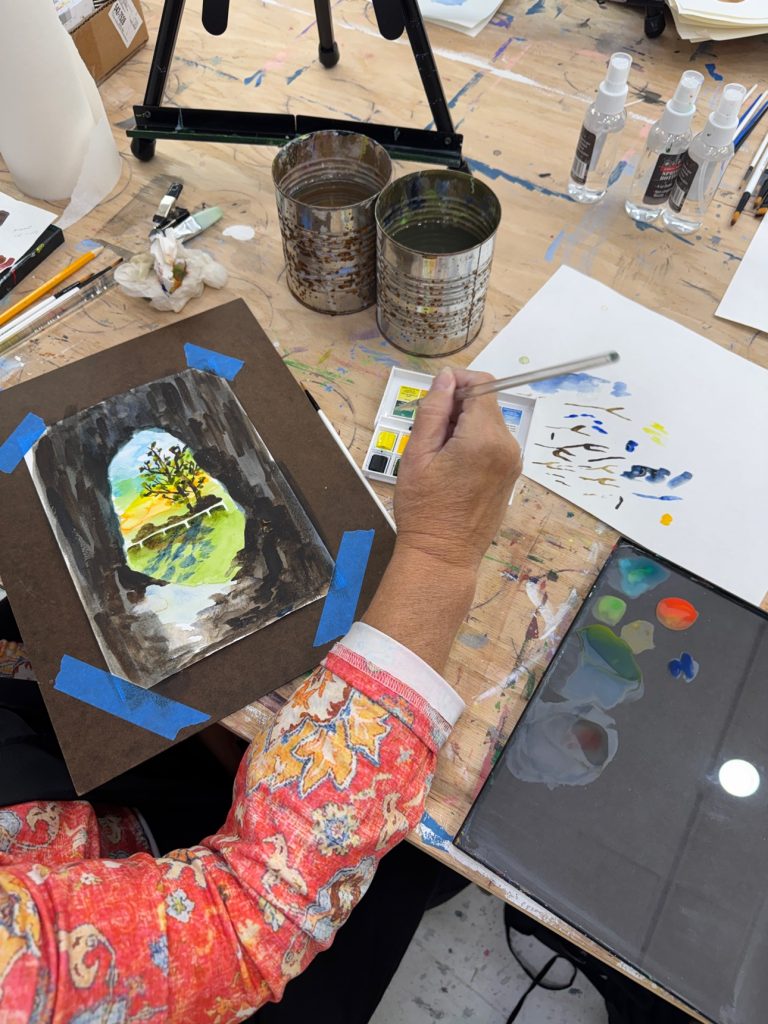
The watercolor painting course meets on Thursdays. Watercolor is taught as a discipline of preparation: how the paper is wetted, how much pigment the brush carries, which passages are planned and which are left to the water. Students begin with controlled studies and build toward finished paintings across a session.
Neither course runs on a fixed script. Each evening’s teaching is set by the paintings in the room and the people behind them. A beginner from Las Colinas and a returning student from south Irving get different problems in the same three hours, which is exactly how a studio class should work. Sessions run in short blocks through the year. Current dates and open seats are on the class pages, and the art classes overview compares both courses in one place.
Workshops That Come to You in Irving
For Irving groups, the teaching travels west instead. A workshop runs about ninety minutes in your room. The teacher brings paints, brushes, canvases, table covers, and printed instructions, sets up in half an hour, teaches the session, and cleans up. Every participant leaves with a finished painting.
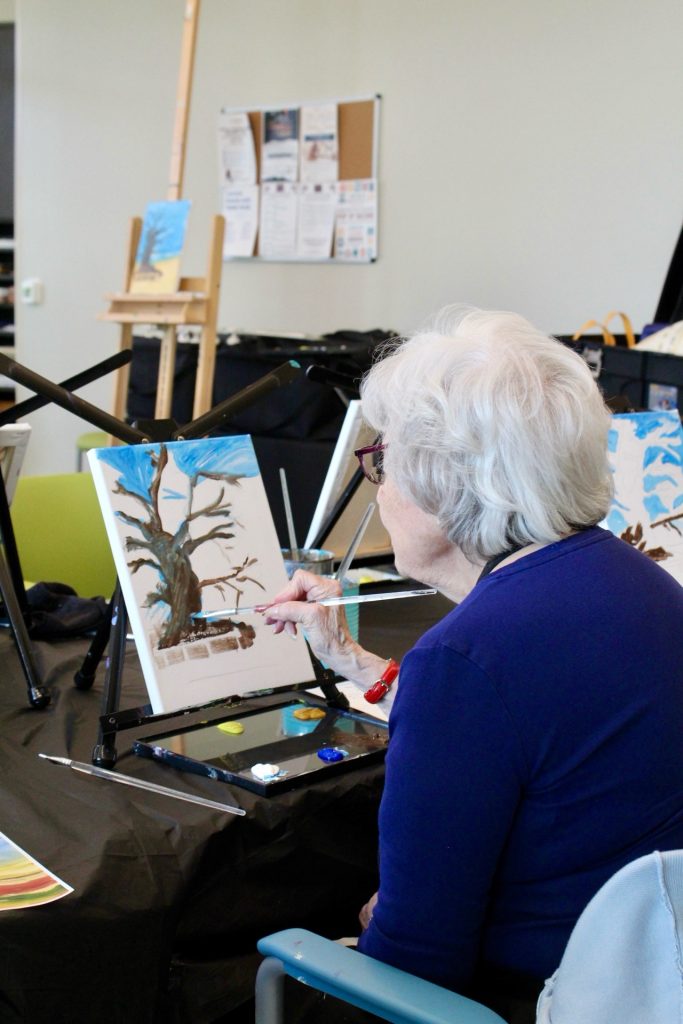
Senior communities across Irving book these workshops for their residents. Irving’s older neighborhoods and its newer senior living communities both run full activity calendars, and a painting workshop gives residents a quiet, social ninety minutes with something to show for it. Canvases arrive with the drawing already sketched, so nobody needs drawing skill to succeed, and memory care groups are paced gently.
Corporate teams are Irving’s signature booking. Las Colinas and the airport corridor hold the headquarters and offices of national companies, and their teams book painting events for holiday parties, project launches, and appreciation days. A group of up to thirty paints together for ninety minutes, with everything handled. The offer is set out on the art workshops page.
Private groups and one on one lessons are available too, at the studio, for Irving residents who want teaching built around a single goal, such as a portfolio or a first exhibition.
Irving and the Arts
Irving built its arts infrastructure on purpose, with city money and a master plan, and the result is stronger than most residents realize. These are the places we send Irving students.
Irving Arts Center. The city’s home for the arts, on MacArthur Boulevard, owned by the city and a Smithsonian Affiliate. It houses ten resident arts organizations, two theatres, and galleries that run rotating exhibitions of regional, national, and touring work. Gallery admission is free, and the galleries are open Tuesday through Saturday. For a painting student, the Arts Center is the place to study how exhibitions are hung and how serious regional work looks at full size, twenty minutes from home.
Mustangs of Las Colinas. At Williams Square in Las Colinas, nine bronze mustangs, one and a half times life size, run through a granite watercourse in the middle of the office district. Sculpted by Robert Glen and installed in 1984, the group was long described as the largest equestrian sculpture in the world. It is the metroplex’s great piece of public art, and our students are assigned it directly: draw the horses from three sides and you will understand animal anatomy and bronze light better than any photograph teaches. The small Mustangs museum beside the square explains how the work was made.
Mandalay Canal and Lake Carolyn. Below the towers of Las Colinas, a Venetian style canal winds between offices and apartments, with walkways, water taxis, and bridges. It is Irving’s most paintable built landscape: stone, water, reflections, and evening light, open to anyone who walks it.
University of Dallas. The Catholic university on Irving’s western side, opened in 1956, runs a serious art program from the Haggerty Art Village on its campus, with the Haggerty Gallery showing rotating exhibitions during the academic year. The university’s art students and visiting shows give Irving a second, quieter exhibition venue, and its grounds, on the wooded hills above the Trinity, are among the prettiest in the city.
Irving Archives and Museum. Downtown, in the former central library building, the city’s museum opened in 2020 and tells Irving’s story with photographs, artifacts, and a permanent exhibition on the city’s history, including its years as the home of Texas Stadium. Its old photographs are drawing references and local history in one stop.
Jackie Townsell Bear Creek Heritage Center. In southwest Irving, the center preserves the story of Bear Creek, a community founded by freed slaves in the years after the Civil War and one of the oldest African American communities in Dallas County. Its museum and historic houses matter to any student who wants to understand whose city this also is.
What Irving Students Paint
Irving hands its students a modern subject set: towers, water, bronze, and the river bottom that was here before all of it.
The Mustangs at Williams Square are the standing exercise. Bronze horses at full gallop, water thrown at their hooves, pink granite and glass towers behind. Students draw them in pencil first, from the plaza, and the good drawings become paintings back at the studio.
The Mandalay Canal supplies the reflection studies: stone bridges doubled in still water, office towers softened by evening. Watercolor students in particular are sent there, because a canal at dusk is a complete lesson in values.
Campion Trail, running along the Elm Fork of the Trinity River, gives Irving its landscape studio: bottomland woods, river bends, and herons, inside the city limits. Students walk it with cameras and come back with a season of landscape material.
The Heritage District on Main Street, Irving’s original downtown, offers the small town subjects: brick storefronts, the old water tower, a main street that predates everything in Las Colinas by seventy years.
Most Irving students pick one of these and stay with it across a session. A subject you can revisit between classes, photographing it in new light, teaches the core professional habit: a painting is made by looking at the same thing longer than anyone else bothers to.
A Short History of Irving
Irving was founded in 1903 by two railroad men, J. O. Schulze and Otis Brown, who platted a townsite between Dallas and Fort Worth on the Rock Island line. The settlement had earlier names, Gorbit, then Kit, but the founders chose Irving, after the author Washington Irving, said to be a favorite of Brown’s wife, Netta Barcus Brown. The town incorporated in 1914. For its first half century it was a farming community shipping cotton, corn, and wheat to the two big cities on either side.
Two decisions remade it. The University of Dallas opened on the western hills in 1956, and Texas Stadium, the Dallas Cowboys’ home, was completed in 1971. Then, in 1973, rancher and developer Ben Carpenter began building Las Colinas on his family’s ranch land: a 12,000 acre master planned community of offices, lakes, canals, and homes that became a model copied across America. DFW International Airport, part of it inside Irving’s borders, had opened in 1974. Between the airport, the stadium, and Las Colinas, Irving went from farm town to corporate city in one generation, reaching about 257,000 residents by 2020.
The city that resulted is one of the most international in Texas, home to communities from across Asia, Latin America, and Africa, many drawn by the airport and the headquarters economy. Its students reflect that. Our Irving classes mix engineers, nurses, airline staff, and retirees from a dozen countries, and the mix is part of what the class learns from: twelve lives looking at one still life produce twelve different paintings.
Getting to the Studio from Irving
The studio is in Richardson, northeast across the metroplex. From Las Colinas and north Irving, TX 161 and the President George Bush Turnpike run east to the studio side of Richardson, about thirty minutes in the evening. From central and south Irving, LBJ Freeway (I-635) east to US 75 north is the usual route. From the airport side, allow a few extra minutes. Classes start at 6 PM, and Irving students build the crossing into the routine: it is the same drive thousands make daily in the other direction for work.
DART’s Orange Line serves Irving’s stations and runs through downtown Dallas to the Red Line, which reaches Richardson’s Arapaho Center and Galatyn Park stations. It works, but it is a long ride with a transfer, and most Irving students drive. Parking at the studio is free and close to the door.
Questions Irving Students Ask
How long is the drive, honestly?
About thirty minutes from Las Colinas in the evening, a little more from south Irving. It is the longest regular student drive we have, and Irving students renew anyway, because the class is three hours and the group is small.
Why not just take a class at the Irving Arts Center?
You should use the Arts Center; it is excellent, and its programs are mostly larger, shorter, and project based. Our studio course is the other shape: four to six students, one teacher, sustained work on your own paintings across weeks. Many students do both.
Do I need experience or supplies?
Neither. All materials are included, and complete beginners are the normal starting point. The teacher demonstrates every stage before you attempt it.
Can our Irving company book a painting event at our office?
Yes, for groups up to thirty. Everything travels with the teacher, including setup and cleanup. Start at the art workshops page with your date and group size.
Can I give a class as a gift?
Yes. A gift art class covers a full session at the studio, and the person receiving it chooses the course and session.
Start Painting, Irving
Irving already invested in the looking: the Arts Center, the Mustangs, the canal. The studio across the metroplex is where the making happens, one small class at a time. Choose the acrylic painting course on Tuesdays or the watercolor painting course on Thursdays, and check the current session on the class page.
Every city we serve is listed on the Where We Teach page. Follow the studio on Instagram and Facebook to see student work as it comes off the easels.