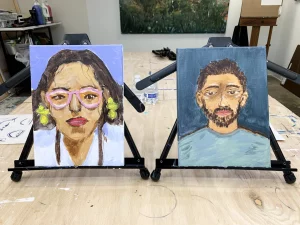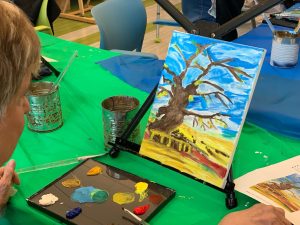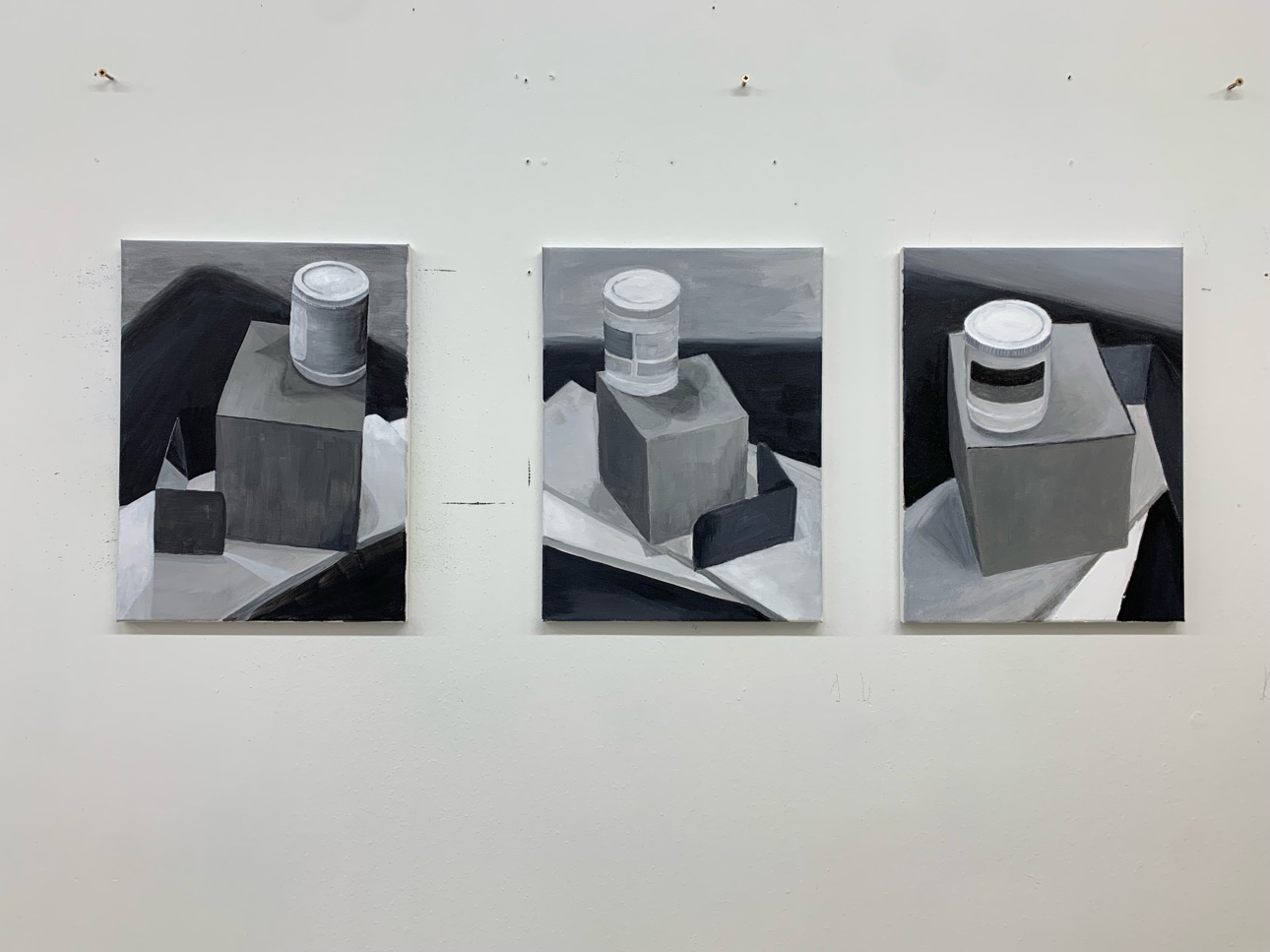
Every painter I know fights the same question. It comes near the end of a painting, when the big decisions are made and the work slows down. Is it finished? Or does it need one more thing?
Students ask me this in class almost every week. They stand at their easel, brush in hand, and look at me like the answer is a fact I am keeping from them. It is not a fact. It is a judgment, and it is the hardest judgment in painting. It is easy to start a painting. It is much more difficult to finish one.
I fight the same question in my own studio, with my own paintings, every single week. So this page is not a rule I hand down. It is how I think about the end of a painting, in my work and in my teaching, and what I tell students when they reach the point where one more brushstroke could help or could ruin everything.
A painting is built in layers
To understand what finished means, it helps to understand what a painting is made of.
When I start a painting, it starts with an idea in my head. Once I have that idea, I either sketch it or find reference photographs that can be used as a starting point. If it is an oil painting, I start with a brief sketch of the things I want in the composition. Then I use rough mark making on the canvas. After that I refine the painting in more delicate phases.
I think about this process like a chocolate cake. When we look at a cake, we see the final layer of cream or chocolate on top. That is all we see. But when we cut a piece out, we see everything that went into it. We see all the layers. We see the flavors and the different colors. We see the cake bread, and we can get into the moisture of it, and maybe some fruits.
A painting is built the same way. What a viewer sees is the top layer. Underneath it are layers of mark making, brush strokes, and also the fears and issues with the painting itself. Those layers are not hidden failures. They are the structure. A painting is finished when those layers add up to a whole, the way the slice of cake holds together. It is not finished when the surface looks polished. Some of my most polished passages sit on paintings that are not done. Some rough ones are complete.
This is why the question is so hard. You are not judging the surface. You are judging everything underneath it, most of which only you can see.
What I am looking for at the end
In my own work, the painting builds a connection between representation and abstraction. I like to think of it as a perfect marriage. Neither figuration nor abstraction takes over the painting. Both unite, and together they create a unique color and form.
That marriage is what I am checking at the end. Every painting has a problem it is trying to answer. It might be a problem of light, or of space, or of how a figure holds together. The painting is finished when the color and form answer that problem. Not when every corner is tidy. Not when it looks like the reference photograph. When the problem is answered, more paint does not improve it. More paint only decorates it, and decoration on top of a solved problem is where overworking begins.
For a student, the problem is simpler, but the logic is the same. Your painting set out to do something. Maybe it was to make the light fall across a table. Maybe it was to make a vase sit solidly in space. When the painting does that thing, it is close to finished, even if small passages still bother you.
Signs that a painting is finished
There is no checklist that ends a painting. But there are signs I have learned to trust, in my studio and in class:
- You step back, and the painting holds together from across the room. Painting is partly done at a distance. Stepping back from the canvas is a real part of the work, and a finished painting survives it.
- Your eye travels through the painting instead of getting stuck. In an unfinished painting, one unresolved area pulls your eye back again and again. When nothing grabs and holds your eye hostage, the painting is settling.
- The changes you are making have become very small. You are moving a tone half a step, softening one edge, adjusting a color slightly. Small changes are not wrong. But when an hour of small changes leaves the painting looking the same, the painting is telling you something.
- You are fixing the same passage for the third time. A passage that keeps being repainted is usually not the problem. The problem is that the painting around it is done, and that one passage is where your doubt has decided to live.
- You cannot say what the next brushstroke would improve. Wanting to continue is not a reason. If you cannot name what the next mark is for, the next mark is a risk, not an improvement.
None of these signs works alone. Together, they describe a painting that has stopped asking you for things.
Why feeling dissatisfied proves nothing
Here is the part students find hardest to believe. Sometimes, even when I do not feel absolutely satisfied with what I see, the painting actually is finished.
That is the problem and the question every painter fights. I fight it every day in the studio. The feeling of satisfaction is not a reliable instrument. It lags behind the work. A painting can be complete days before it feels complete to the person who made it.
There are reasons for this. You have been looking at the painting for hours, at close range, while it changed. You remember every version of it. You see the passage that failed twice before it worked. A fresh viewer sees none of that history. They see only what is there. When your judgment is tired and full of the painting’s past, your feeling about it is the last thing you should trust.
Doubt is also not specific. Ask yourself what exactly is wrong. If you can point to it and name it, fix it. If the wrongness is a general cloud over the whole painting, that is usually not the painting. That is fatigue, or the gap between the picture in your head and the one on the canvas. That gap never fully closes, in any painter, at any level. Waiting for it to close is how paintings get worked to death.
The two paints end differently
The medium changes how the ending feels. Acrylic dries fast, and once a layer is dry you can paint over it. That makes acrylic forgiving at the start and dangerous at the end, because there is always the option of one more layer. Watercolor is transparent. What you put down stays visible, so the decision to stop carries more weight earlier. I compared the two in more depth in my guide to acrylic vs watercolor for beginners, if you are choosing between them.
Whichever paint you use, the discipline is the same. At some point you have to protect the painting from its painter.
What to do when you reach that point in class
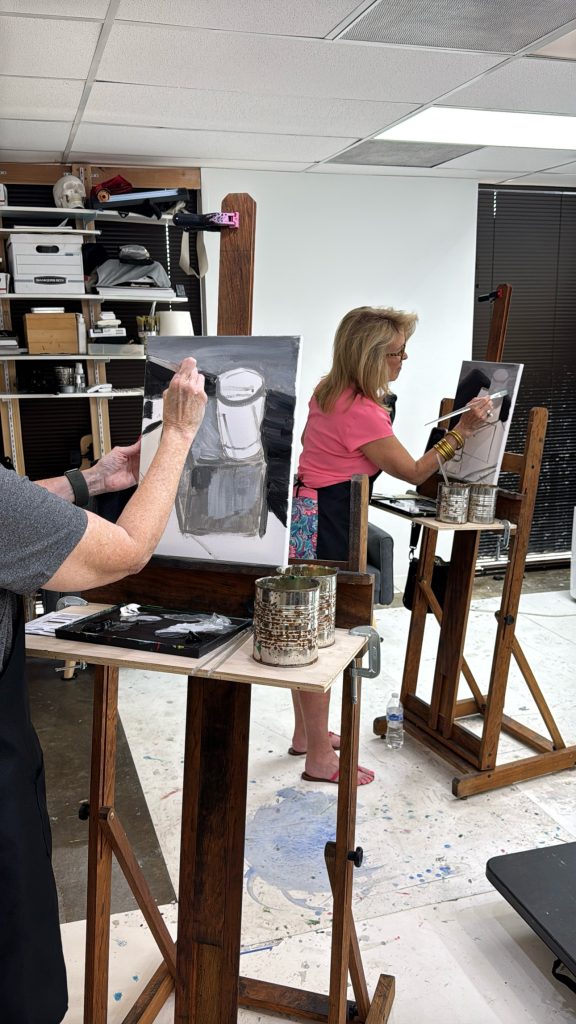
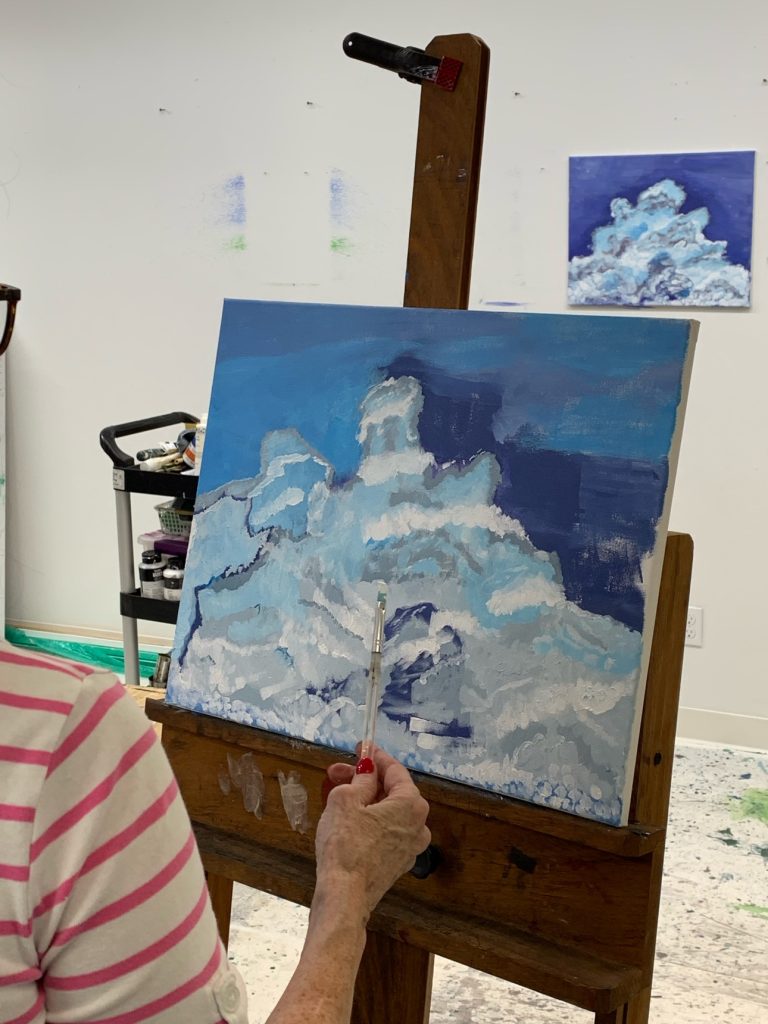
In my evening classes, students work on their own paintings across multi-week sessions. A painting gets more than one sitting, and that structure is deliberate. It means you almost never have to decide, tonight, under pressure, whether a painting is finished.
When a student reaches the doubtful stage, this is what we do:
- We step back from the easel together and look at the painting from a distance, the way a viewer will see it.
- The student says out loud what they think is wrong. Half the time, saying it shows it is one small passage, not the whole painting.
- If something specific needs fixing, we fix that one thing, and nothing else.
- Then the painting rests until the next session. Fresh eyes the following week settle most arguments. A painting that looked unfinished on Tuesday often looks finished the next week, because the painter changed, not the painting.
I walk the room and help at each easel, so nobody has to make this call alone while they are learning. There is no fixed week by week plan in my classes. The pacing follows the group, and a painting that needs another sitting gets another sitting.
The honest answer
So, how do you know when a painting is finished? You know it the way you know most real things in this craft. Slowly, by looking, and by being wrong in both directions. Every painter has stopped too early and has ruined a good painting by going too far. Both mistakes teach the same judgment.
What I can tell you is this. A finished painting is not a perfect painting. It is a painting whose layers hold together and whose problem is answered. And the doubt you feel at the end is not evidence against it. It is simply the last layer, the one every painter carries out of the studio with them.
If you want to practice this judgment with a teacher at your easel, the acrylic painting class meets on Tuesdays and the watercolor painting class meets on Thursdays, both in the evening at my studio in Richardson. You can read more about the academy and how I teach on my artist website.
If you are buying for someone else, an Art Be You gift card covers a full session in either class. You can also follow the academy on Instagram and Facebook, where I post class work and new sessions.