Almost every adult who walks into our studio asks some version of the same question. Should I learn to draw first, and only then start painting? Or can I go straight to paint?
It is a sensible question. Drawing feels like the foundation, and painting feels like the house built on top of it. Nobody wants to build in the wrong order. But the honest answer surprises most people: for an adult beginner, the order matters far less than starting at all, because drawing and painting teach overlapping skills, and a good painting class teaches drawing inside the painting.
This article lays out what each skill actually teaches, where they differ, and how to choose your starting point based on what you want to make.
What drawing teaches you
Drawing is the study of looking. When you draw, you have almost nothing to hide behind. A pencil, an eraser, and a sheet of paper. Everything you know, and everything you only think you know, shows up on the page.
Drawing teaches three things better than anything else.
Proportion. How big is the head compared to the shoulders? Where does the horizon cross the building? Drawing forces you to measure with your eyes, and that measuring habit transfers to every painting you will ever make.
Values. Most of what we call drawing is really the arrangement of light and dark. A drawing in five values, from white paper to deep black, already contains the whole structure of a picture. Paintings fail most often in their values, not in their colors, and drawing is where values are learned cheapest and fastest.
Confidence in line. A drawn line is a decision. Making thousands of them, in sketchbooks and studies, builds the hand control that later makes brushwork look deliberate instead of accidental.
Drawing is honest, and that is its value
Students sometimes find drawing discouraging for exactly the reason it is good for them. A wrong proportion cannot be covered with pretty color. The mistake sits there and teaches. Painters who draw regularly improve faster, because their errors are exposed early, while they are still cheap to fix.
Drawing travels anywhere
The other great virtue of drawing is that it needs nothing. A pencil and a sketchbook fit in a bag. You can draw at an airport, in a waiting room, on a lunch break. Students who keep a small sketchbook build more looking hours into a week than students who only paint in scheduled sessions, and looking hours are what progress is made of.
What painting teaches you
Painting includes drawing, but it adds two large subjects that drawing alone cannot teach.
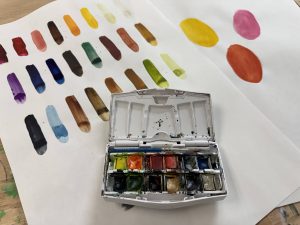
Color. Mixing, temperature, harmony, and the strange fact that a color changes depending on what sits next to it. Color is learned by mixing paint, not by reading about it. Every painter’s education is mostly a long series of mixtures that did not do what was expected, until gradually they do.
Wholeness. A painting has to work as one thing. The sky relates to the ground, the figure relates to the chair, the bright note in the corner answers the dark mass on the other side. Painting teaches you to hold the whole picture in mind while working on a small part of it, which is the central professional skill.
Painting is forgiving in a different way
Beginners expect painting to be harder than drawing because it has more moving parts. In one respect it is easier. Paint can be corrected. Acrylic especially can be painted over, adjusted, and reworked in a way a pencil drawing cannot. A student who fears the blank page often relaxes at an easel, because the first layer is understood to be a draft. In our acrylic painting course, every painting literally begins as a drawing on the canvas, then gets built over in stages, so the fear of a wrong start has nothing to attach to.
The real differences, side by side
If you are choosing where to begin, these are the differences that actually matter in daily practice:
- Starting cost. Drawing needs pencils and paper. Painting needs paint, brushes, and a surface. At our studio all painting materials are included, but for home practice drawing is the cheaper habit.
- Space and mess. Drawing happens anywhere and cleans up in seconds. Painting wants a table, water, and some protection for the floor. For home practice, a small permanent corner is enough, and we have a full article on setting one up among the recent posts on this site.
- Speed of first results. A beginner’s first drawing lesson produces visible progress in an evening. Painting takes a few sessions before the results feel like yours, because color mixing has to be learned alongside everything else.
- How mistakes work. Drawing mistakes are visible and cheap. Painting mistakes are correctable but can compound if the values underneath are wrong.
- What you end up with. Drawing fills sketchbooks, which become your visual diary. Painting produces finished objects for walls. Many students want the objects, and that desire is a legitimate reason to start with paint.
Which one first? The practical answer
Art schools traditionally teach drawing first, and for a teenager entering a four year program that order makes sense. For an adult learning in weekly classes, a different rule works better: start with the one you will actually keep doing.
If the idea of a wall of your own paintings is what pulls you, start painting. You will learn drawing inside it, because every painting in our courses starts with a drawn structure, and your teacher will correct that drawing before color ever touches it. The drawing you learn this way is not a lesser drawing. It is drawing with a purpose attached.
If you are patient, love observation, and want the cheapest, most portable practice, start drawing, in a sketchbook, daily if you can. Your future paintings will thank you. When you move to paint later, your values and proportions will already be in place, and only color will be new.
What does not work is waiting. The most common failure we see is not choosing the wrong order. It is spending a year deciding, buying supplies for both, and starting neither.

The tradition, and why it does not settle the question
The drawing first rule comes from the old academies, and it was not wrong for its purpose. Apprentices in earlier centuries spent years drawing from casts and models before they were trusted with paint, because paint was expensive, the training was long, and the profession demanded a level of draftsmanship that took a decade to build.
An adult starting weekly classes in 2026 is in a different position. Your goal is probably not a decade long apprenticeship. It is to make real paintings, improve steadily, and enjoy the process enough to keep it in your life. Modern materials also changed the equation. Acrylic paint is cheap, dries fast, and can be corrected, so the cost of learning drawing inside painting, and fixing the drawing as you go, is low. The tradition is worth respecting. It is not a law that fits every student.
A one week test, if you still cannot decide
If the choice still feels stuck, settle it with experience instead of arguments. Give each skill three short sessions in one week:
- Two drawing sessions, twenty minutes each. Draw one object in your kitchen, twice, from two angles. Notice whether the looking itself holds your attention.
- One painting session, however rough. Copy a simple photograph in any paint you have, or in a single color. Notice whether working in paint feels like play or like stress.
- Judge by the pull, not the product. Both first attempts will be clumsy. The right starting point is the one you found yourself thinking about afterward, the one you want to try again tomorrow.
Students who run this test usually arrive at the studio already decided, and they arrive more committed than students who chose from a list of pros and cons.
How our classes teach both together
In the studio, the two skills are not separated into different courses, because real paintings do not separate them.
In the acrylic painting course, each painting begins with drawing: the composition is drawn on the canvas and corrected, then a tonal underpainting fixes the values, then color is built in stages. A student weak in drawing gets that weakness addressed in the first hour of every painting, with the teacher at the easel.
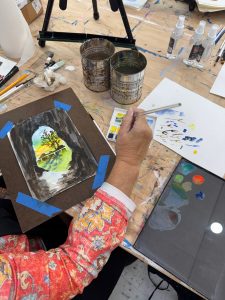
In the watercolor painting course, drawing matters even more, because watercolor cannot be painted over. The pencil plan under a watercolor is its skeleton, and students learn to draw a clean, light plan before the first wash goes down.
Students who want extra drawing practice are given sketchbook assignments between classes, small and specific: a kitchen chair, a pair of shoes, the view from one window at two times of day. Ten minutes of drawing a day does more than an hour once a month.
Questions beginners ask about this choice
I cannot draw a straight line. Can I paint?
Yes. Straight lines are what rulers are for. Drawing for painting is about proportion and looking, not about mechanical perfection, and it is taught in small steps. Almost every adult beginner believes their drawing is worse than it is. The first class usually corrects that belief.
I drew as a child and stopped. Does that count?
It counts more than you think. Skills from childhood drawing return quickly once you start again, usually within a few weeks. Adults returning to art after decades often progress faster than true beginners, because the looking habits are still in there.
Is drawing boring compared to painting?
Drawing is quieter, not boring. A good drawing session has the same absorption as painting, with less setup. Students who find drawing dull are usually drawing subjects they do not care about. Draw what you love looking at, and the problem disappears.
Can I learn both at the same time?
That is what most of our students do, whether they planned it or not. Paint in class, draw in a sketchbook at home, and let the two feed each other. The art classes overview explains how the courses are structured if you want to see where you would fit.
The short answer
Drawing teaches you to see. Painting teaches you to build. Neither one is a gate you must pass before the other, and an adult beginner does best by starting with whichever one pulls harder, inside teaching that treats them as one craft.
If you are still deciding, read our guide to your first painting class and the one on how to choose a painting class in Dallas. Or simply start: pick the acrylic painting course or the watercolor painting course, and let the first painting settle the argument.
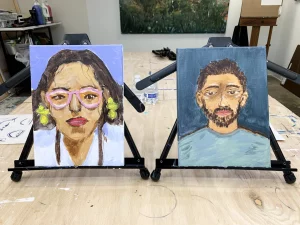
My own work as a painter, which you can see on my website, rests on drawing done daily for years. It is also how I teach at the academy: drawing and painting together, from the first session. Student work from the studio appears on our Instagram and Facebook pages.