Most people who sign up for a painting class with me are a little nervous before the first evening. That is the normal case, not the exception. Many of my students have not painted since school. Some have not touched a brush in twenty years. Some in forty.
So this page does one simple thing. It walks through what actually happens at your first painting class, stage by stage, so there are no surprises. Nothing about the evening is a test. You are not graded. You are not compared to anyone. You come, you paint, and you learn by doing it.
I teach evening classes for adults at my studio in Richardson. Acrylic is on Tuesdays and watercolor is on Thursdays, each from 6 to 9 PM. This walkthrough fits either evening.
Before you arrive
You bring nothing. That part surprises people, so I will say it plainly. Every material is provided: paint, brushes, paper, canvas, water, all of it. You do not buy a supply list before the first class. You do not need to own anything at all.
The one thing worth thinking about is what you wear. Wear something you do not mind getting a spot of paint on. Acrylic washes off skin easily, but once it dries on fabric it is permanent. An old shirt solves the whole problem. Watercolor is kinder to clothes, but the same advice costs you nothing.
You also do not need experience. There is no assumed knowledge at the door. If you have never mixed a color in your life, you are in the same position as most of the room.
The 6 PM start is deliberate. It leaves room to finish the workday, eat something, and get to the studio without rushing. The class sits after your day, not in competition with it. Most people arrive a few minutes early, settle in, and are ready when the evening begins.
Walking in
When you arrive, your spot is already set up. Your materials are waiting at your place. You sit down, and the evening can start without any fuss about equipment.
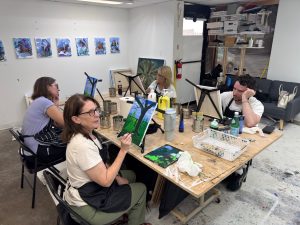
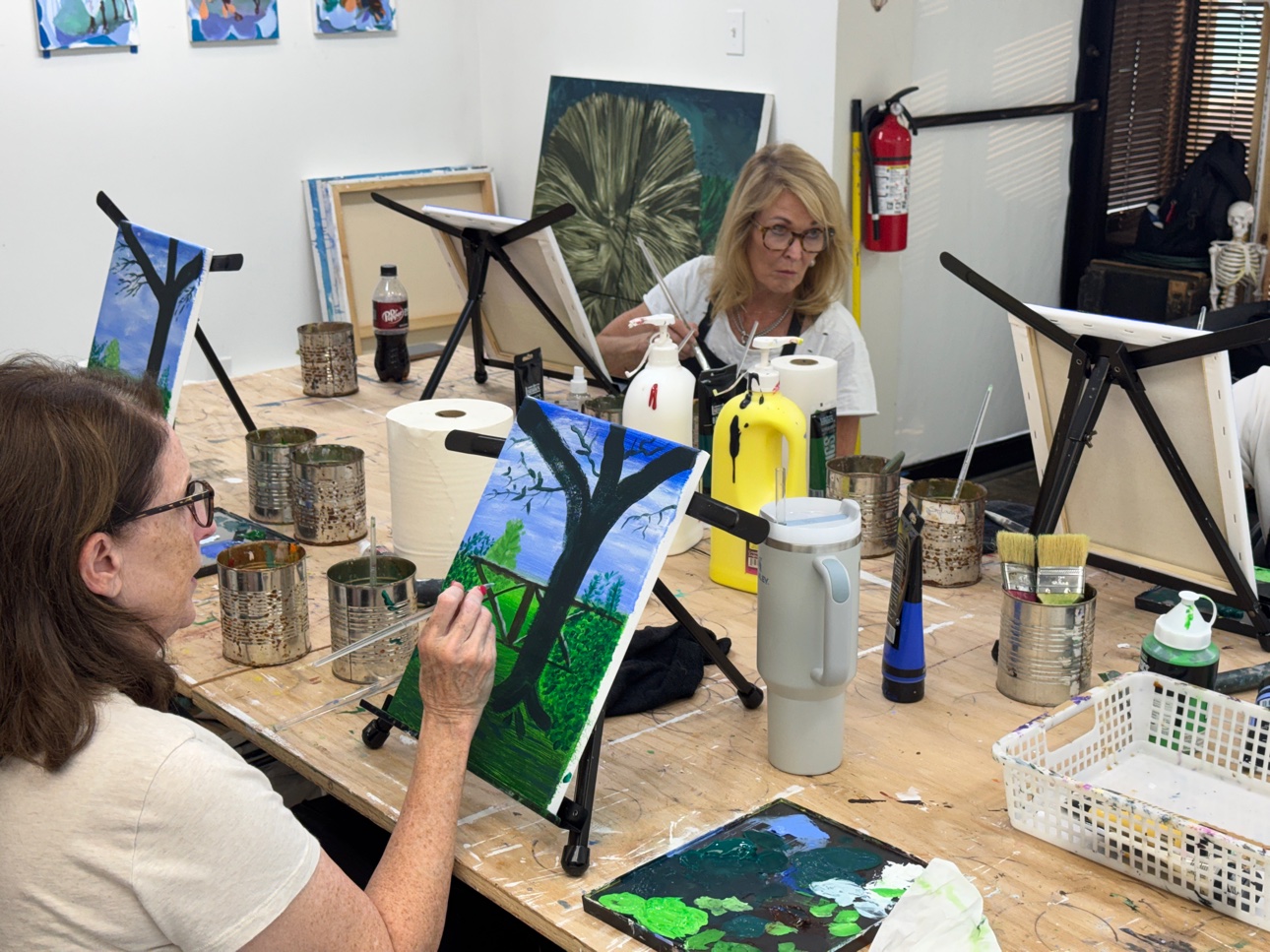
The group is small. Studio classes usually run four to six people. You will meet the others in the first few minutes, and you will notice something quickly: complete beginners are normal here. The person next to you may be holding a brush for the first time since childhood, just like you.
The sentence I hear most in my studio is this one: “I can’t draw a stick figure.” People say it like a warning. It does not matter here. Painting is mostly about looking carefully and learning to mix the color you actually see. Drawing a stick figure is not the skill involved. Adults learn the looking part faster than they expect, because they already know how to pay attention.
How the evening starts
I teach the class myself. I am a working painter, and I teach what I practice in my own studio. Painting is my day job as well as my teaching. I exhibit my own paintings nationally, including a solo exhibition in Ohio opening in November 2026. When you ask why a color behaves the way it does, the answer comes from work I am making right now.
The evening usually opens with a short demonstration. I show the group what we are working on and how to approach it. You watch first. You see the steps before you have to take them. Questions are welcome at that point and at every point after.
There is no fixed week by week plan pinned to the wall. Every group is different, so the pacing follows the people in the room. If the group needs more time on mixing, we take more time on mixing. If everyone is ready to move on, we move on. I would rather teach the people in front of me than follow a chart.
Painting, with help at your easel
After the demonstration, you paint. This is most of the evening. The room settles down, people work at their own pace, and the talking quiets into the friendly kind.
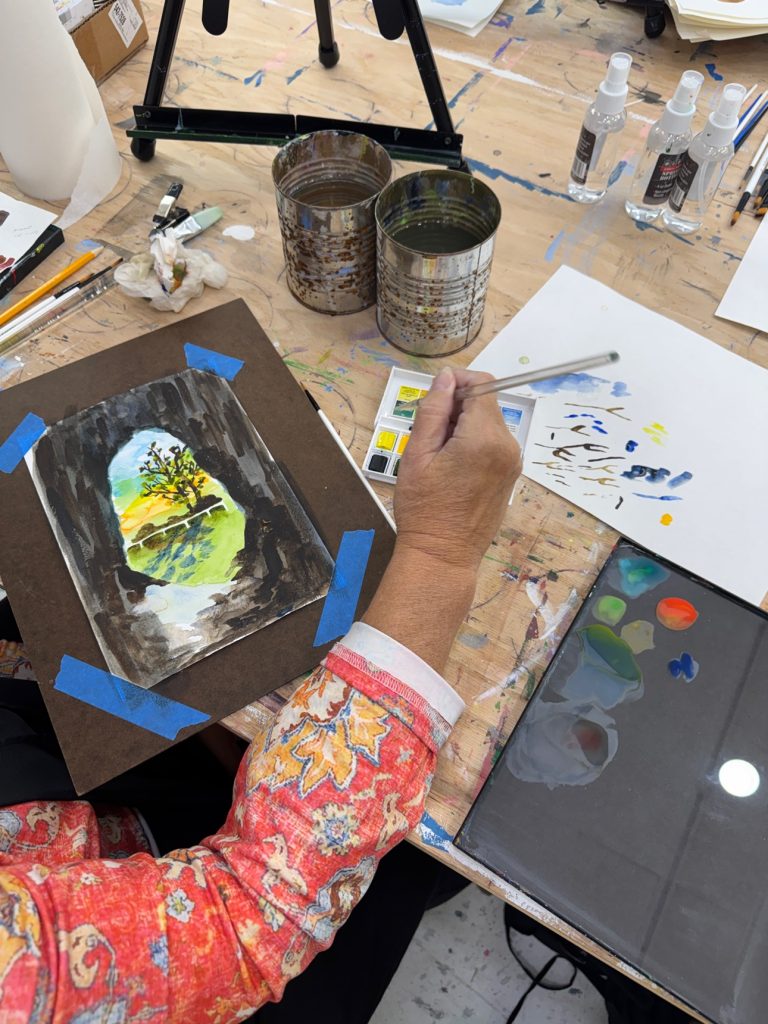
I do not stay at the front. I walk the room and help at your easel, with your painting, while it can still change. That is the part a video can never give you. I can look at the exact passage you are stuck on and show you what to do next, on the painting in front of you. Sometimes the help is a sentence. Sometimes I pick up a brush and show you the move, then hand it back.
Mixing color is where beginners need the most guidance, and that is fine. Nobody mixes the right color on the first try. You learn what each color does by putting it in a mix and watching what happens. I wrote a separate guide about learning to mix colors, including skin tones, if you want to see how that part is taught.
The first painting will wobble
Here is the honest part. Your first painting will probably wobble. Lines will land where you did not intend them. A color will come out stronger or duller than you planned. This happens to everyone in the room, including people who later turn out to be very good at this. It happened to me when I started. It is not a sign about your talent. It is what a first attempt at anything looks like.
The two paints handle the wobble differently. Acrylic dries fast, and once a layer is dry you can paint over it. A passage that went wrong is not ruined. It is covered. Watercolor is transparent and less forgiving. You plan a little more, and some surprises stay in the painting. Either way, a wobble is information. It shows you exactly what to try next.
Nobody in the room is watching your painting as closely as you are. Everyone is busy with their own. Within the first hour, most people stop feeling self-conscious, because the work takes over their attention.
Leaving with work in progress
At the end of the first evening, you may not have a finished painting. That is expected, and it is not a problem. Classes run in multi-week sessions, so your painting continues at the next class. You leave it with a clear sense of where it is going, and you pick it up again the following week with fresh eyes.
This is one reason I teach in sessions instead of one-off nights. A painting needs more than one sitting to become something. Your eye needs the week in between, too. People often walk in for the second evening already seeing what they want to fix, before I say a word.
What changes by the second and third evening
The second evening feels different from the first in a few reliable ways:
- You know where everything is. Your spot, your materials, the rhythm of the evening. Nothing is new except the painting.
- The group is familiar. You remember names. Being a beginner around people you know is much easier than being a beginner around strangers.
- Your mixing gets closer on the first try. Not perfect. Closer. You start adjusting on purpose instead of by accident.
- You ask better questions. Instead of “is this right,” you ask “how do I make this edge softer,” and that question has a useful answer.
By the third evening, most people have stopped thinking about whether they belong in a painting class. They are thinking about the painting. That shift is the real start of learning, and it comes quickly.
Something else happens between evenings. You start noticing light and shadow during the ordinary week, on a wall, on a face, across a table. Nobody assigns that. It is a side effect of looking carefully for three hours at a time. Students mention it often, and it is a good sign. It means the class is working even when you are not in it.
My evening art classes for adults in Richardson have run full or near-full since February 2026, so the groups stay steady. The same faces return across a session, and that steadiness helps beginners relax.
Two evenings to choose from
You pick the medium, or you pick the day of the week. Both are good reasons.
The acrylic painting class meets on Tuesdays. Acrylic is opaque, dries fast, and lets you paint over mistakes. It suits people who like bold color and quick results. The watercolor painting class meets on Thursdays. Watercolor is transparent, light, and dries paler than it looks wet. It suits people who like a calmer, more planned way of working.
If you are torn between them, I wrote a plain comparison to help you decide between acrylic and watercolor as a beginner. There is no wrong answer. Skills you learn in one medium carry into the other.
How to sign up
Classes run in multi-week sessions rather than single drop-in nights, and every material is included. The class pages carry the current session dates, the price, and the seats still open, so what you find there is always up to date:
- Acrylic painting class: check availability and the next sessions here
- Watercolor painting class: check availability and the next sessions here
Sessions run through the year, and a new semester starts in the new year. If the current dates do not fit your schedule, the next round will.
You can read more about the academy and my teaching on my artist website. When you are ready, pick the evening that fits your week and enroll through those class pages.
Your first evening will not be perfect. It is not supposed to be. It is supposed to be a start, with materials waiting, a small group in the same position, and a teacher at your easel when you need one. That is all a first painting class has to be.