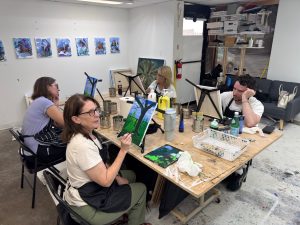
Here is the pattern every painting teacher knows. A student buys supplies, paints at the kitchen table twice, spends forty minutes setting up and cleaning up each time, and quietly stops. The painting did not fail. The logistics failed.
The students who keep painting at home share one thing, and it is not a big house or a spare room. It is a spot, sometimes no larger than a card table, where the easel stays up, the palette stays out, and starting again takes two minutes instead of twenty. This article is about building that spot: where to put it, how to light it, what to protect, and the short list of things actually worth buying.
The rule: permanent beats perfect
A painting space works when it removes decisions. If the easel is up and yesterday’s painting is still on it, you will paint for twenty minutes while dinner cooks. If everything lives in a closet, you will not.
Judge every choice in this article by one question: does it make starting easier? A beautiful studio that must be assembled fails that test. An ugly corner that is always ready passes it.
Choosing the spot
Almost any small area qualifies if it has most of the following:
- A wall or corner where an easel or a board can stay standing between sessions.
- A floor you can protect, or one you do not mind protecting, because paint travels.
- Access to water within a reasonable walk, for brushes and jars. A bathroom sink down the hall is fine.
- A door or a boundary, if your household includes small children or pets with opinions about wet paint.
- Enough quiet that you can stand in it for half an hour without being in the family’s traffic lane.
Corners that work well in real houses: the end of a dining room, a wide hallway landing, a guest room corner, a section of a garage with decent light, an enclosed porch. Watercolor painters need even less, a desk corner genuinely suffices, because the whole kit fits in a tray.
Light: the one thing to get right
Light matters more than furniture. Bad light makes good color impossible, because you mix what you see, and if the light lies, the mixture lies.
Daylight is best, from the side. A window to your left if you are right handed, or the reverse, gives even light without your hand shadowing the work. Direct sun blasting the canvas is too much; bright shade near a window is ideal.
Evening painters need a lamp that tells the truth. Choose a bulb or lamp described as daylight balanced, in the 4000K to 5000K range, with a high color rendering rating if it lists one. Warm yellow household bulbs make every mixture look richer than it is, and paintings lit by them disappoint in daylight. This one purchase fixes more home paintings than any other.
Keep the light consistent. Painting half a picture under a window and half under a lamp is how skies change color overnight. One steady light source, every session, is the goal.
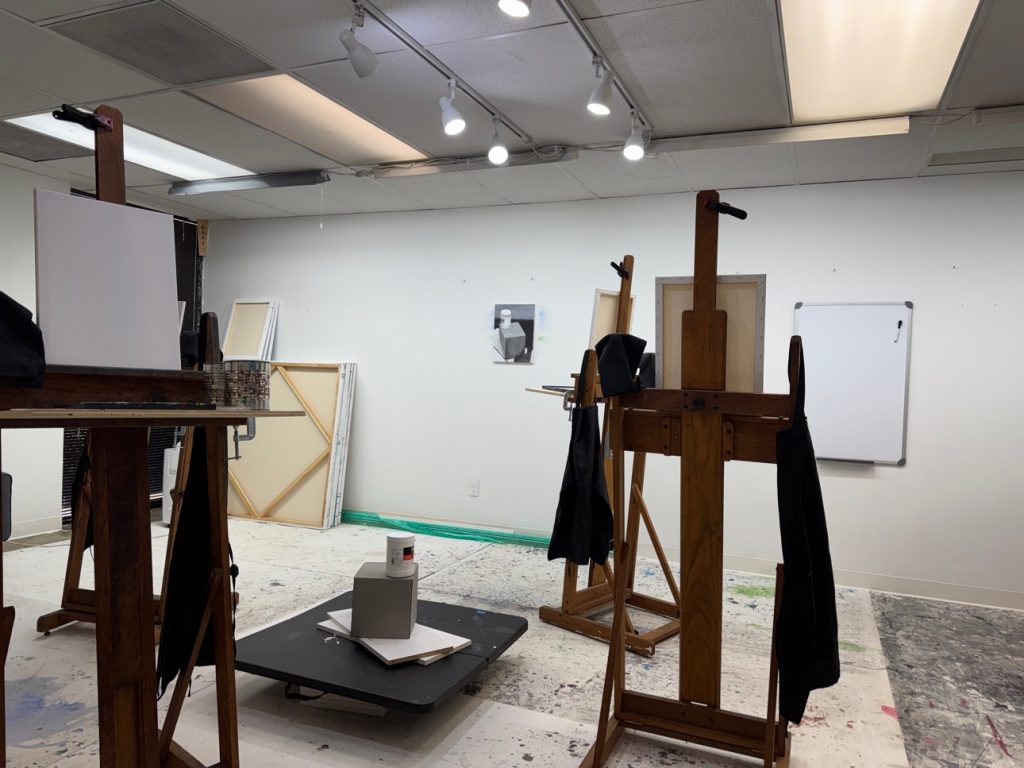
Surfaces and easels
You need something that holds the work at a slight tilt, at a height that lets your shoulder relax.
- Table easels suit small canvases and watercolor boards, take no floor space, and live on any table or desk. For most home painters this is the right start.
- A frame or H frame floor easels hold bigger canvases and feel like a studio. Buy one only if you know you paint large, or will.
- The wall option: a picture ledge or two hooks and a board lean works for panels and paper, and costs almost nothing.
- Watercolor painters mostly need a board: a piece of lightweight board bigger than the paper, to tape or clip the sheet down, tilted slightly on a book or a stand.
Whatever you choose, tape this rule to it: the center of the painting should sit a little below eye level when you work, standing or seated. Paintings worked on flat tables get distorted by perspective, and the distortion only shows when the picture is hung.
Protect the room, then relax
Paint on floors is the number one cause of home painting bans. Spend one afternoon on protection and never think about it again:
- A washable mat, a piece of vinyl flooring offcut, or a canvas drop cloth under and around the easel.
- A table cover that lives with the setup: an old tablecloth or a plastic cloth you do not care about.
- An apron or one set of painting clothes, kept with the supplies, so changing takes a minute.
- A lidded jar or a small bin at the easel for paper towels and dried paint, so waste does not migrate through the house.
Acrylic dries into plastic and comes off most hard floors with warm water if caught early. Watercolor is water based and forgiving. Neither justifies anxiety once the mat is down.
Storage that keeps you painting
Storage has one job: keep everything within arm’s reach and visible enough that you remember what you own.
- Paints in one box or drawer, tubes standing or lying in a single layer if you can. If you cannot see a color, you will buy it twice.
- Brushes in a jar or roll, handles down, heads up and unbent. Our brush guide covers shapes, sizes, and care in full.
- Paper and canvases vertical, like books on a shelf, never stacked flat under weight.
- Work in progress leaning on the wall near the easel, where you see it while doing other things. Paintings get finished by eyes that keep meeting them.
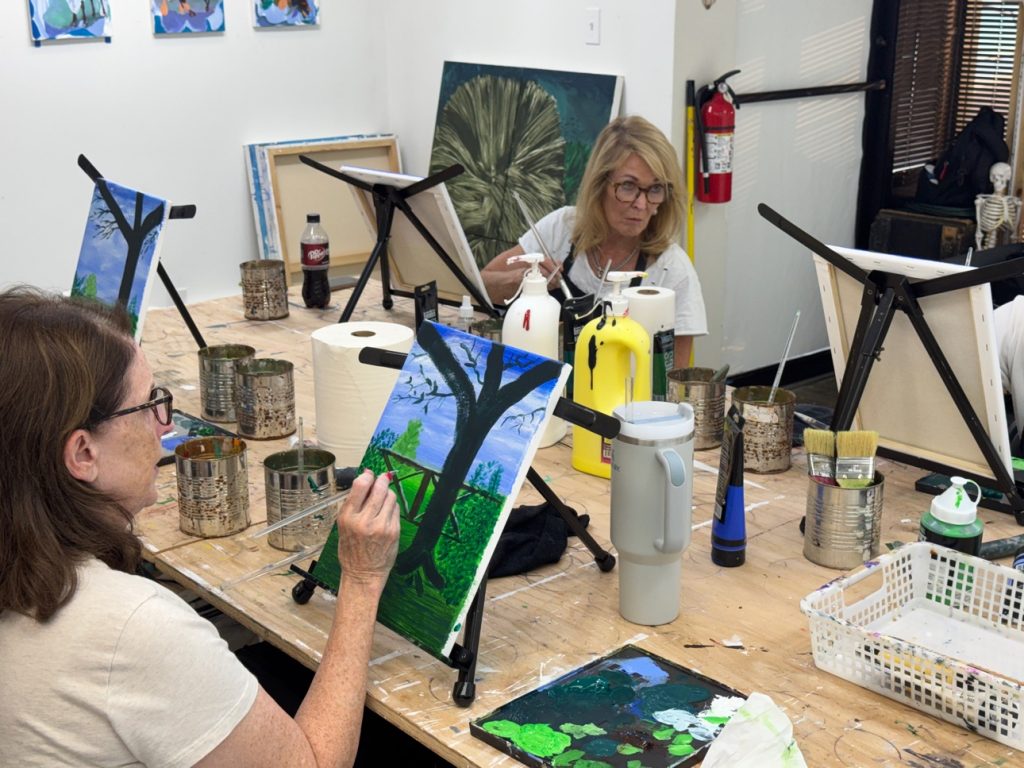
Acrylic setup versus watercolor setup
The two mediums ask slightly different things of the space.
Acrylic at home
Acrylic painters need water in two jars, one for rinsing, one cleaner jar for mixing, because acrylic turns rinse water to soup quickly. You need a palette you can scrape or peel: a stay wet palette, a glass sheet, or disposable palette paper. Acrylic dries fast indoors, which is good for layering and bad for palettes left open; a lidded palette box keeps mixtures workable between sessions.
Watercolor at home
Watercolor needs the least space and the best light discipline, because its colors are judged wet and dry lighter. You need a sloped board, two water jars, a mixing plate or a pan set, and a place where a wet sheet can dry flat and undisturbed for an hour. A tray that holds the whole kit means a watercolor painter can set up on any table in three minutes and clear it in two, which is why busy people love it.
The short starter list
Resist buying the art store. Students who practice at home between classes need only this:
- The easel or board described above.
- One good daylight lamp, if you paint in the evening.
- A surface to paint on: canvas boards or a pad of canvas paper for acrylic; a block or pad of watercolor paper for watercolor.
- A basic set of paints, the same core colors used in class, so home and studio mixtures match.
- A few brushes in the shapes you actually use, plus two water jars and a roll of paper towels.
- One mat, one table cover, one apron.
Everything else, extra colors, gadgets, specialty tools, should be bought in response to a painting that needed it, not in advance of one that might.
The kitchen table version, done right
Some homes genuinely have no corner to claim. If the kitchen or dining table is your only surface, the setup can still work, but it has to be designed as a kit rather than a space:
- Everything in one lidded box or tray that you can carry with two hands: paints, brushes, jars, palette, paper towels.
- A table easel or board that lives on top of the box between sessions, so the whole studio moves as one object.
- A five minute setup ritual, always in the same order: cover down, easel up, water fetched, painting out. Rituals defeat the friction that kills table painting.
- A drying spot that is not the table. A wire shelf, a spare chair by the wall, the top of a bookcase: wet work needs somewhere to be while life reclaims the table.
Watercolor painters win this arrangement most easily, since the entire kit fits in a single tray. Acrylic painters should favor a stay wet palette box, so an interrupted session does not mean a dried, wasted palette.
Where finished paintings live
A home setup is not complete until it answers the question nobody asks at the start: where do the paintings go? A productive year produces more work than beginners expect.
- A drying and curing shelf for recent work, out of traffic, where acrylics can sit untouched for a few days.
- A vertical storage slot, between two pieces of board or in a portfolio against a wall, for dry work awaiting frames or decisions.
- A rotation on the walls. Hang your own finished work at home and change it as better pieces arrive. Living with your paintings is how you learn what they need, and it is also, frankly, the reward the whole setup exists for.
- A honest discard path. Studies and failures can be painted over, for acrylic on board and canvas, or recycled. Keeping everything forever turns the painting corner into an archive, and archives do not invite new work.
Habits that make the space work
The space is only half of it. The other half is how you use it:
- Leave the painting out. The single strongest habit. A visible, unfinished painting pulls you back.
- Stop mid passage sometimes. Ending a session with one obvious next step makes the next session start itself.
- Keep a sketchbook in the space for the ten minute days. Drawing counts, and our article on painting versus drawing explains how the two support each other.
- Photograph work in progress under the same light each time. Photos show value problems your eyes have stopped seeing.
Bring it back to class
Home practice and studio teaching are built to feed each other. Students bring home paintings into the acrylic painting course and the watercolor painting course for correction, and they take class methods back to their corners and card tables. The art classes overview shows how the courses are organized, and our guide to your first painting class covers what the studio provides, which is everything, so your home setup can grow slowly and only where it helps.
A painting space is not a purchase. It is a small standing invitation, set up once, that your future self keeps accepting. In my own working life, the studios have ranged from a warehouse to a wall, and the wall produced paintings too, because the easel was up. You can see the work that came out of those spaces on my website, and how the teaching side works on the academy page. Student home setups, some of them very small and very productive, show up on our Instagram and Facebook.