People ask me this before they sign up, and they ask it again on the first evening, usually while looking at a blank canvas. How long does it take to learn to paint?
The honest answer has two parts, and both are true. You start learning on the first evening. You make real progress inside one session. And the learning does not have a finish line where a teacher hands you a certificate and declares you a painter. I have painted for years. Painting is my day job as well as my teaching, and I am still learning things at my own easel.
So if you are asking how long it takes, the better question is what changes, and when. That I can answer plainly, because I watch it happen in my studio every week.
The short answer
If by learning to paint you mean starting, making real paintings, and understanding what you are doing and why, then one session is enough to begin properly. A session runs for several weeks. By the end of it, a beginner has mixed real colors, built a painting in stages, and finished work they can point at.
If you mean painting with ease and judgment, where your hands do what your eyes intend, that takes months of regular evenings. Nobody gets there in a weekend. Nobody gets there in one class, including the classes I teach.
What you do not need is talent as a starting condition. In my experience, the students who improve are the ones who attend. The evenings add up. Talent, whatever it is, has never once shown up in my studio as a substitute for attendance.
What the first evening teaches
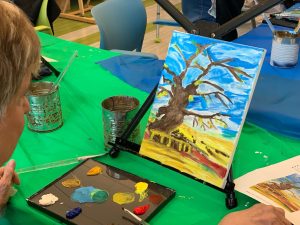
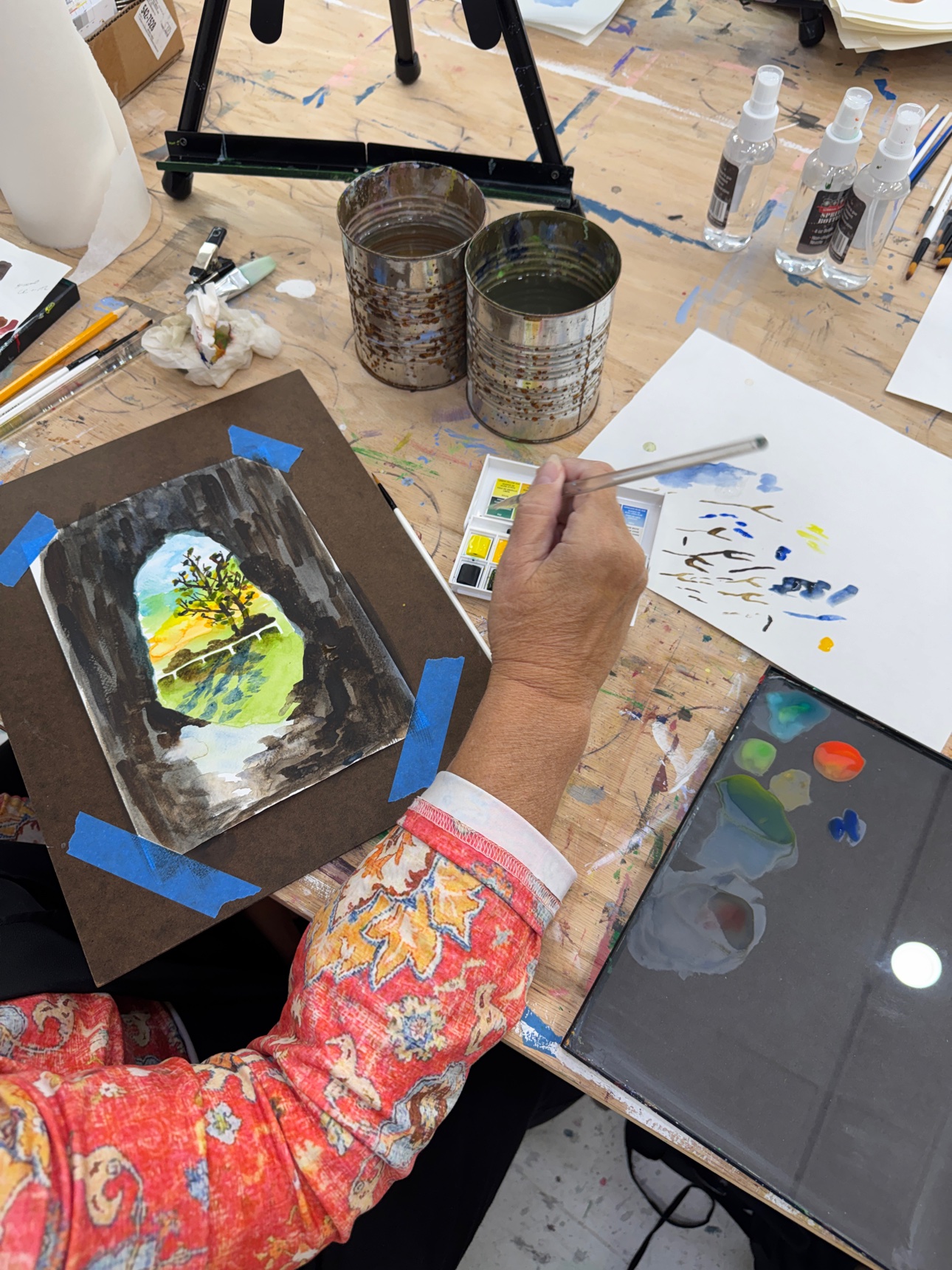
On the first evening you meet the materials. You learn how the paint behaves, how much water it wants, how a brush loads and lets go. You make your first marks and your first mixes.
Nobody mixes the right color on the first try. That is not a failure. That is the normal first step for everyone who has ever painted, and I include myself. The first mixes teach your eyes what the colors do. Every mix after that is informed by the ones that missed.
Your first painting may not be finished by the end of the evening. That is expected too. Paintings continue at the next class, with fresh eyes, and seeing your own work again after a week away is itself part of learning. I describe the first evening in full in my walkthrough of what happens at your first painting class, if you want the detail before you come.
What changes by the second and third evening
The second evening feels different, and students say so. Your spot is familiar. The room is familiar. The rhythm of the evening is familiar. Nothing is new except the painting in front of you, and that frees your attention for the work itself.
Your mixing gets closer on the first try. Not perfect. Closer. You begin adjusting on purpose instead of by accident.
Your questions change, and this is the change I trust most. On the first evening people ask, is this right. By the third evening they ask, how do I make this edge softer. The first question has no useful answer. The second one does, and asking it means you are starting to see like a painter.
Something else happens between evenings. Students tell me they start noticing light and shadow during the ordinary week. On a wall. On a face. Across a table. Nobody assigns that homework. It is a side effect of looking carefully for three hours at a time, and it means the class is working even when you are not in it.
By the third evening, most people stop wondering whether they belong in a painting class. They are thinking about the painting instead. That shift is the real start of learning, and it comes quickly.
What one session builds
There is a reason I teach in multi-week sessions instead of one-off nights. A single evening can show you that painting is enjoyable. It cannot build skill, because skill is a loop: mix, paint, get it wrong, find out why, paint again. That loop needs more than one evening to turn even once.
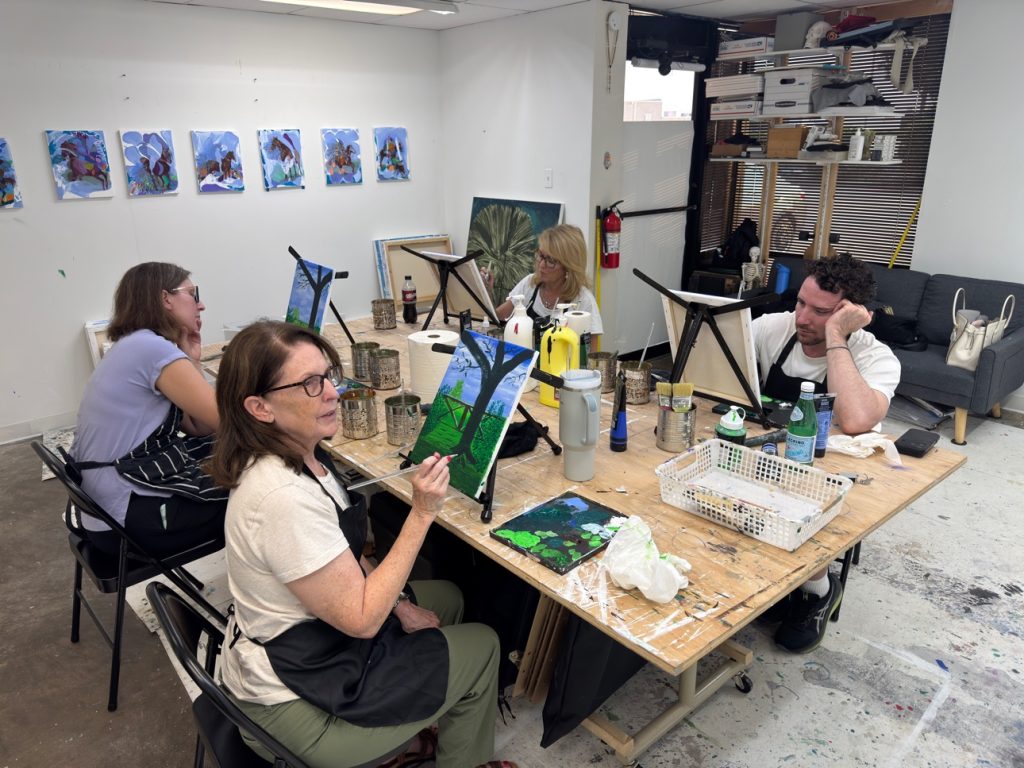
Across a session the loop turns many times, with a teacher at your easel while the painting can still change. Your painting from the first evening continues. New problems appear as the work grows, and you solve them with help, then with less help.
There is no fixed week by week plan in my classes. The pacing follows the people in the room. If a group needs more time on mixing, we take more time on mixing. If a group is ready to move on, we move on. Learning measured this way does not run on a printed schedule. It runs on the group in front of me.
Which evening, which paint
The two paints teach at different speeds, and that is worth knowing before you choose. Acrylic dries fast and lets you paint over mistakes, so the loop of trying and correcting turns quickly. Watercolor is transparent and less forgiving, so it teaches planning and patience earlier.
I wrote a plain comparison of the two for beginners choosing a first class: acrylic and watercolor as a beginner. The acrylic class meets on Tuesdays and the watercolor class meets on Thursdays, each from 6 to 9 PM at my studio in Richardson. Either medium will teach you to paint. The skills carry across, so the choice is about which way of working suits you, not about which one is faster to learn.
What takes months
Some things do not arrive in one session, and it is better to say so plainly. They include:
- Knowing when a painting is finished, and when it is only stuck
- Recovering calmly when a passage goes wrong
- Seeing temperature in color, warm against cool, not just light and dark
- Mixing closer to the color you intend on the first try
Judgment takes months. Knowing when a painting is finished, and when it only feels stuck, is a slow education. So is recovering well when a passage goes wrong. Beginners panic at a mistake. Painters with a few months behind them see information: the color was too strong, the edge was too hard, the value was too dark. The mistake becomes a direction.
Seeing takes months too. Your eyes learn in layers, the same way a painting is built. First you see shapes. Then values. Then temperature, warm against cool. Each layer of seeing opens the next one, and no teacher can hand it to you faster than practice does.
None of this is a warning. It is the good part. A skill that took months to build is yours in a way a weekend trick is not.
What never really ends
I exhibit my own paintings nationally, and I still stand in front of canvases that resist me. The questions get better. The problems get more interesting. The learning does not stop, and I would not trust a teacher who told you theirs had.
That is built into how I teach. The classes are part of a working painter’s practice, not a script read aloud. You can read more about the academy and how the teaching connects to my own work on my artist website.
What I will not promise you
I will not promise that you will paint well in three evenings, because that promise is a sales line, not a fact. I will not promise a method that skips the wobbling stage. There is not one. Every painter I know passed through paintings that disappointed them, usually many of them.
What I can promise is smaller and real. You will be taught by the person whose name is on the class. You will get help at your own easel, on your own painting, while it can still change. And you will improve at the speed your attendance allows, which turns out to be faster than most beginners expect.
The only honest measure
My evening classes have run full or near-full since February 2026, in small groups of four to six people. Watching those groups, I can tell you what predicts progress, and it is not the first painting. It is the fifth evening, and the tenth. It is the student who keeps coming back while the work is still wobbling.
So, how long does it take to learn to paint? An evening to start. A session to build the foundation. Months to gain judgment. And a lifetime, if you want one, to keep going.
Bring nothing when you come. Every material is provided. Pick the evening that fits your week, and let the evenings add up.
If you want to give someone else the start, an Art Be You gift card covers a full session. Class photos and new session announcements go on the academy’s Instagram and Facebook pages.